Your knee does not need another lazy quad stretch while the rest of your leg does nothing. That is the mistake. You hold a position for 30 seconds, stand up, and expect the joint to feel "released."
Mobility exercises for knee stiffness work best when they are not treated as stretching alone. The knee needs comfortable motion, yes. But it also needs the quads, hamstrings, glutes, calves, and hips to produce and control force through that motion. If the muscles around the joint are weak, the knee keeps moving like a loose hinge under load.
The evidence is not subtle here. Exercise improves stiffness, pain, leg strength, and position sense in people with knee osteoarthritis. Aerobic work performs especially well for pain and function. What it does not prove is that one stretch, yoga pose, foam roller drill, or "knee unlock" trick restores lost knee range of motion in every situation.
That claim belongs in the trash.
Why movement beats passive stretching for knee stiffness
A stiff knee can feel like a joint problem, but the answer is often a whole-leg problem. Your knee sits between the ankle and hip. If the ankle cannot travel forward, the calf is rigid, the quad cannot control knee bend, or the hip collapses inward, the knee gets stuck doing a job it was not built to do alone.
Passive stretching has a place. It can make bending or straightening feel more tolerable in the moment. But it does not teach your knee to accept load. It does not build quad capacity. It does not improve your ability to step down, rise from a chair, walk uphill, or control a split squat.
For knee joint mobility, use three layers:
1. Low-impact movement to warm the joint. Walk, cycle, march, or step at an easy pace for 5 to 10 minutes. Get heat into the tissues before you ask the knee for deeper motion.
2. Controlled range work to reclaim usable motion. Bend and straighten the knee under light control. Do not fling the joint around.
3. Strength through the range you can own. Use quads, hamstrings, glutes, and calves to make that range durable.
The American Academy of Orthopaedic Surgeons uses exactly this logic in its knee-conditioning approach: a low-impact warm-up, stretching for the calves, quads, and hamstrings, then strengthening for the quads, hamstrings, hips, and glutes.
A knee that can bend passively but cannot control a step-down is not mobile enough for real life.
The distinction matters. Flexibility is a position. Mobility is controlled access to that position. Functional knee exercises build the second one.
The movements that earn their place in a home routine
Do not turn this into a 45-minute circus of banded drills. Pick movements that cover knee flexion, extension, ankle contribution, hip control, and leg strength. Then repeat them long enough to get better.
1. Heel slides: regain knee bend without forcing it
Heel slides are the cleanest starting point when bending feels restricted after inactivity or mild stiffness.
Lie on your back with both legs straight. Brace lightly so your pelvis does not tip and your lower back does not arch hard. Slide one heel toward your glute. Let the knee bend only as far as you can control without sharp pain, catching, or a sense that the joint is blocking. Pause. Slide the heel back out and actively straighten the knee.
The detail people miss: do not drag the heel in with a twisted hip. Keep the kneecap pointing up. Pull with the hamstrings, then squeeze the quad as you straighten.
- Use 8 to 12 slow reps per side.
- Pause for one to two seconds at the end of each direction.
- Start with a sock on a smooth floor or place a towel under the heel to reduce friction.
This is not a test of toughness. It is a way to repeatedly practice the bend-and-straighten pattern without bodyweight compressing the joint.
2. Quad set to straight-leg raise: lock down knee extension control
A knee that will not fully straighten often makes walking feel awkward and makes the quad switch off. You do not fix that by yanking the knee straight. You teach the quad to create extension.
Sit or lie with the working leg straight. Put a rolled towel under the knee if that helps you find the contraction. Pull the toes toward your shin. Squeeze the quad hard enough to press the back of the knee down toward the floor or towel. Hold. Relax.
Once you can create that contraction cleanly, add a straight-leg raise. Lock the knee first. Then lift the entire leg from the hip without letting the knee soften halfway up.
| Movement | Main job | Setup cue | Common failure |
|---|---|---|---|
| Quad set | Rehearse knee extension and quad tension | Pull toes up, squeeze the thigh, press knee down | Pushing with the heel while the quad stays relaxed |
| Straight-leg raise | Hold extension while the hip flexes | Lock the knee before lifting | Letting the knee bend and turning it into a hip-flexor swing |
| Terminal knee extension with a band | Control the final part of straightening under light resistance | Keep hip stacked, squeeze quad at full extension | Snapping the knee back or rotating the foot outward |
Use 2 to 3 sets of 8 to 15 controlled reps. With quad sets, use holds of roughly 5 seconds. Make every rep deliberate. A vague contraction gives you a vague result.
3. Supported knee-over-toe rocks: restore the ankle's share of the job
Many people chase knee range of motion while ignoring the ankle. Then they squat and the heel rises, the arch collapses, and the knee has nowhere clean to travel.
Face a wall. Put one foot several inches away, heel flat. Drive the knee forward toward the wall over the middle toes. Keep the heel glued down. Do not let the knee cave inward. Rock forward under control, then return.
This is an ankle mobility drill, but it earns its place in a knee routine because normal knee bend during squats, stairs, and lunges depends on the shin moving forward.
If your knee protests in this position, reduce the range. Move the foot closer to the wall and keep the motion small. Your job is to build a clean groove, not win a distance contest.
Perform 2 sets of 10 to 15 rocks per side.
4. Sit-to-stand: make knee bend useful
A chair is not beneath you. It is a brutally honest training tool.
Sit toward the front half of a stable chair. Plant your whole foot. Keep ribs stacked over pelvis. Reach your hips back slightly, then drive through the midfoot to stand. Squeeze the glutes at the top. Sit back down under control; do not drop.
The knee should travel in line with the second or third toe. It does not need to stay vertically above the ankle. Knees are designed to move forward. What you do not allow is a collapse inward, a heel that peels up, or a hip that twists away from the working side.
To regress, raise the seat with cushions or use your hands lightly on a counter. To progress, lower the seat, slow the lowering phase to three seconds, or hold a light load at chest height.
Use 3 sets of 6 to 12 reps. Stop each set while the movement still looks like a movement, not an escape plan.
5. Split squat hold: build strength in the range that usually feels weak
Stiff knees often hate the transition from shallow to moderate bend. That is exactly where a supported split squat hold can help.
Hold a countertop or sturdy support. Take a staggered stance. Keep the front foot flat. Lower straight down until the front knee bends to a tolerable depth. Keep the pelvis level and the front knee tracking over the toes. Brace your trunk. Hold the position.
Do not drift your torso wildly forward. Do not let the front arch collapse. Do not shrug the shoulders toward your ears and hang from the countertop.
Start with 15- to 25-second holds, 2 to 4 rounds per side. When that becomes controlled, perform slow split squat reps: three seconds down, brief pause, stand with the front leg.
This movement trains the quad and glute to stabilize the knee under real bodyweight. That is more valuable than chasing a deeper passive bend on the floor.
Aerobic work is not "extra"—it is part of knee conditioning
Here is the part mobility-only routines miss: the knee needs repeated, low-threat cycles of movement. Walking and stationary cycling do that without turning every session into a max-effort leg workout.
A 2025 network meta-analysis covering 217 randomized controlled trials and 15,684 people with knee osteoarthritis found that aerobic exercise likely produced large short- and mid-term improvements in pain, with mid-term benefits for function, gait performance, and quality of life. That does not mean everyone with a stiff knee has osteoarthritis. It means aerobic work has a serious case for being in the program, not parked in the "optional cardio" category.
For a home-based routine, choose the format your knee can repeat:
- Flat walking: Keep the pace brisk enough to warm you but controlled enough that your stride does not turn into a limp. Start with 10 minutes if needed, then build time gradually.
- Stationary cycling: Use a seat height that allows a smooth pedal stroke without the knee being crammed into deep flexion at the top. Start with light resistance. Pedal circles; do not stomp.
- Low step-ups: Use a low, stable step. Put the whole foot on the platform, drive through the midfoot, stand tall, then lower slowly. The lowering phase is where knee control gets built.
- Marching intervals at home: If you have no bike and no safe walking route, march in place with controlled knee lift and a firm foot landing. Keep it low impact.
Do not confuse sweat with dosage. A sensible session is one that leaves you capable of training again. If the knee becomes dramatically more swollen, unstable, hot, or increasingly painful afterward, that is not productive grinding.
Cardio is not a detour from knee mobility. It is repeated joint motion with a circulation and capacity bonus.
Build the routine in phases, not random exercises
The AAOS conditioning program describes a 5- to 10-minute warm-up, stretches held for 30 to 60 seconds, and a 4- to 6-week structure before moving into maintenance work. Those are useful program parameters, not universal medical commands. Your diagnosis, training history, recent injury, surgery status, and symptom pattern change the dose.
Still, the structure is solid. Use it.
Phase 1: Set up the joint
Start every session with 5 to 10 minutes of easy low-impact movement. Walk, cycle, or march.
Then use one or two light mobility drills:
- Heel slides for knee bend and extension.
- Supported knee-over-toe rocks for ankle contribution.
- A standing quad stretch or lying hamstring stretch, held comfortably for 30 to 60 seconds if those positions feel good.
Do not treat stretching as punishment. Pull the leg into position, breathe steadily, and keep the pelvis from twisting to fake range.
Phase 2: Build the muscular brakes and engine
Choose two to three strength drills:
- Quad sets or banded terminal knee extensions.
- Sit-to-stands.
- Supported split squats.
- Glute bridges.
- Calf raises with a slow lower.
The knee is not protected by avoiding force forever. It is protected by earning force capacity. Squeeze the quad. Brace the trunk. Keep the foot rooted. Control the lowering phase.
Phase 3: Finish with repeatable conditioning
Walk, cycle, or step for 10 to 20 minutes at a manageable intensity. You should be working, but your mechanics should remain clean.
A simple weekly layout might look like this:
1. Three conditioning sessions: warm-up, mobility, strength, then low-impact aerobic work.
2. Two lighter movement days: walking or cycling plus a few heel slides, quad sets, and ankle rocks.
3. One full rest day if needed: no need for heroic volume when the knee is already irritated.
After a reasonable period of consistent work, retain knee strength and range drills two to three days per week rather than dropping them the moment the joint feels better. Stiffness often returns when people remove the exact loading that was helping.
What yoga, Pilates, and foam rolling can—and cannot—do
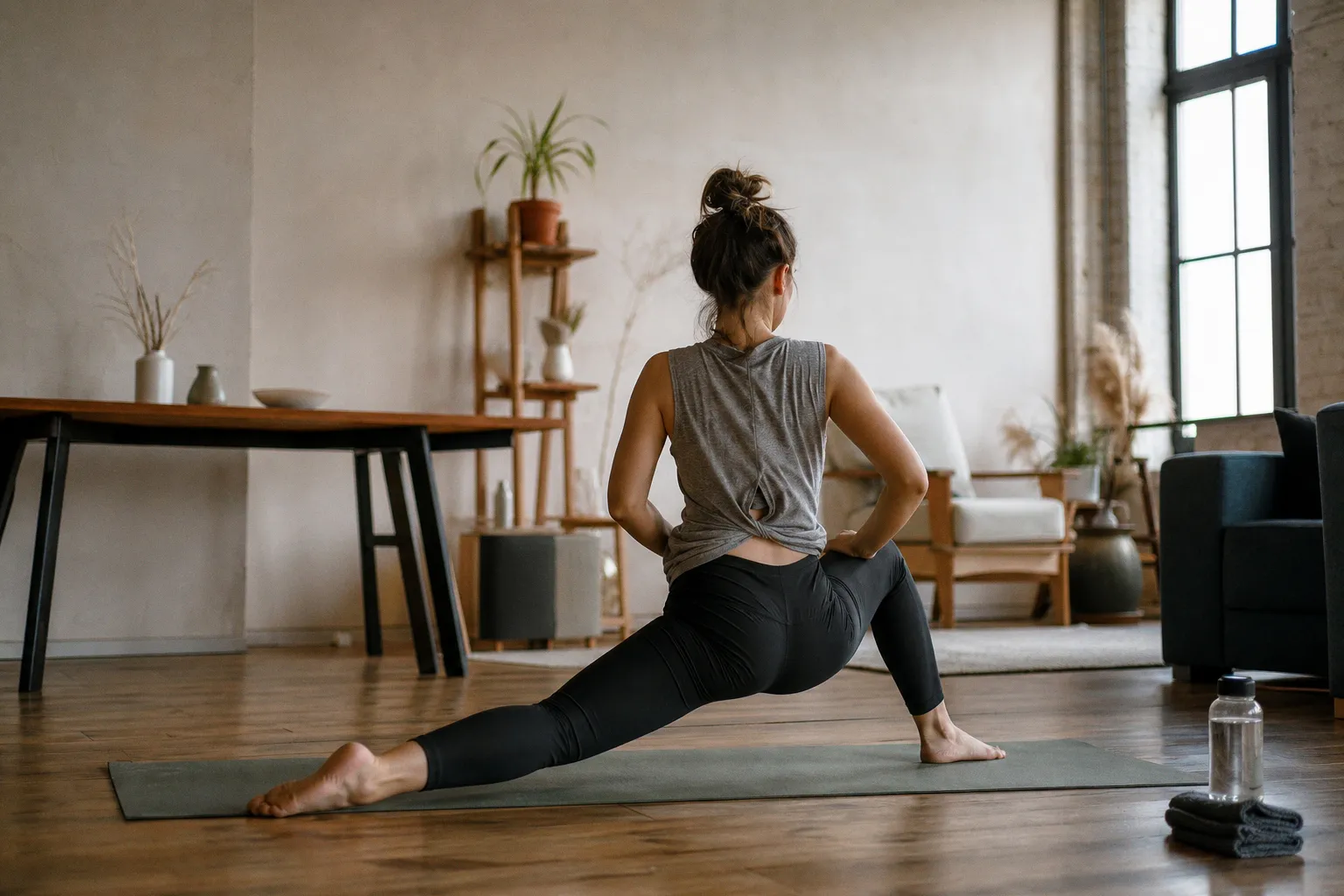
Yoga and Pilates can be useful ways to keep moving, especially if they improve your consistency. Slow flows can build tolerance to kneeling, lunging, squatting, and transitions from floor to standing. Pilates can train trunk and hip control that reduces sloppy lower-limb mechanics.
But call them what they are: general exercise tools, not diagnostic tools and not automatic treatment for every knee problem. A general knee-focused Pilates class may be appropriate exercise for some people with knee symptoms, but it is not a substitute for figuring out why the knee is stiff.
Foam rolling can make surrounding muscles feel less guarded for a short period. Roll the quad, lateral thigh, calf, and hamstring if it helps you move into training more smoothly. Do not grind directly over the kneecap or attack the side of the knee like you are sanding wood. The roller does not realign a joint, dissolve a meniscus issue, or replace strength work.
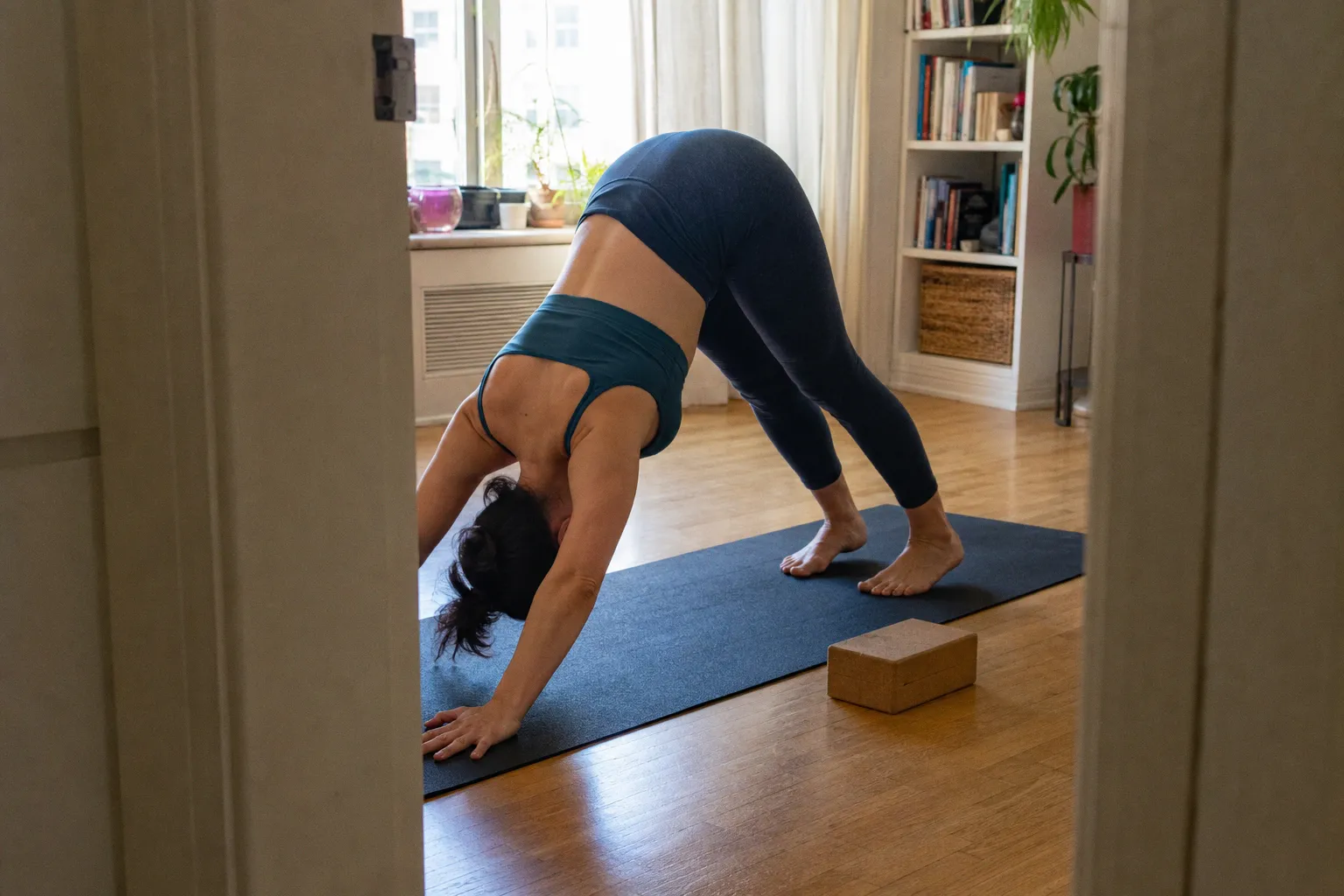
The same rule applies to deep yoga knee flexion. If a pose creates sharp pain, catching, instability, or a hard block, back out. Use props, reduce depth, or choose another pattern. Forcing range against those signals is not discipline. It is bad coaching.
When knee stiffness needs assessment, not another routine
Do not automatically label knee pain or stiffness a mobility issue. The symptom alone does not tell you whether you are dealing with osteoarthritis, swelling, a recent injury, a post-operative limitation, tendon irritation, inflammatory disease, or something else entirely.
Get medical assessment instead of self-programming if the knee is:
- severely painful, very swollen, hot, or red;
- associated with fever or feeling unwell;
- numb, tingling, or causing symptoms down the leg;
- unstable, giving way, locking, or unable to bear weight normally;
- stiff or painful after a sudden traumatic or high-impact injury;
- recently operated on, unless you are following your clinician's specific rehabilitation plan.
Manual therapy, massage, joint mobilization, and soft-tissue work may have a role in some cases, but current guidance for hip and knee osteoarthritis places them alongside therapeutic exercise—not in place of it.
If excess bodyweight is part of an osteoarthritis picture, reducing it can also help. Guidance indicates that any weight loss is likely beneficial, with a larger reduction around 10% of bodyweight likely more beneficial than 5%. That is not a moral lecture. It is load management. Every step asks the knee to manage your mass repeatedly.
The honest target: better function, not a magic range number
You may not get a dramatic, overnight change in knee range of motion. Research supports exercise for stiffness, pain, strength, and function, but the evidence is less certain that exercise reliably restores every degree of lost bending or straightening in knee osteoarthritis. Structural injury, swelling, surgery, and inflammatory conditions can change the picture further.
So measure progress where it counts.
Can you stand from a lower chair without using your hands? Can you walk longer with a smoother stride? Can you descend a step without the knee collapsing inward? Can you bend and straighten the joint with less resistance the next morning? Can you complete more controlled reps before technique breaks?
Those are useful wins.
How long you stay on a given structure depends on the knee you are actually dealing with. A generally healthy joint that stiffens after long desk days usually responds faster than a post-surgical knee or a knee with chronic osteoarthritis. Your training history, age, weight, and what the joint has been through all change the answer. A clinician who knows your imaging, your swelling pattern, and your diagnosis will give you a more useful time frame than any magazine will.
The weekly frequency should match your tolerance, not the calendar. Most knees in reasonable shape tolerate this kind of work three times a week with a lighter day or two between sessions. A knee that flares after each session needs fewer sessions, easier sessions, or a different exercise selection. A knee that does not respond at all in two to three weeks deserves a second look rather than another round of the same work.
Watch for the moments that actually mean something. The first session you feel your quad doing the work in a sit-to-stand instead of the joint just absorbing the load. The first time the knee stops guarding on the stairs. The first morning you stand up without bracing for that catch. Those milestones show up long before any tape-measure number does, and they tell you the program is doing its job.
Train the joint the way you would train anything worth keeping: consistently, honestly, and in doses that let it come back stronger next session.