The point where most home workouts quietly fail is not motivation. It is the moment a regular push-up becomes easy, the hips stop trembling in a split squat, and the body no longer receives a clear reason to adapt.
You can feel it: the chest barely works, the thighs finish the set without that dense, local fatigue, and the session starts to resemble movement rather than resistance training.
That is where a full bodyweight workout plan needs to become more articulate. Not more punishing, not packed with novelty, but more deliberate about tension, range, leverage, weekly volume, and recovery. Muscle does not know whether resistance comes from a barbell, a band, a suspension trainer, or the shifting geometry of your own body. It responds to repeated mechanical challenge, enough food, and enough time for the tissues to rebuild.
“Marcus” is not a documented transformation with a verified before-and-after timeline. He is the familiar home trainee: someone with limited equipment, a floor, perhaps a doorway pull-up bar or a resistance band, and the realistic goal of building a stronger body without turning the living room into a gym. The method is what matters.
The science of home-based hypertrophy is less glamorous than the internet suggests
Home training gets dismissed because it often looks too simple. A push-up, a squat, a plank, a few band rows: visually, none of it carries the theatrical weight of a loaded barbell. Yet the body is not impressed by theatre. It is reading force, muscular tension, joint position, total work, and how close a movement brings a muscle to its current capacity.
The American College of Sports Medicine’s recent resistance-training guidance is refreshingly clear here: regular training of all major muscle groups at least twice per week matters more for most healthy adults than complicated programming, a specific piece of equipment, or a ritual of taking every set to total failure. Bodyweight exercises, elastic bands, and home-based resistance routines can all support strength, muscle growth, and physical function.
That does not mean every no-equipment full body workout automatically builds muscle. A casual circuit of twenty easy air squats, a few half-range push-ups, and some frantic mountain climbers may elevate the heart rate, but it can leave the prime movers underloaded. For hypertrophy, we need a movement to create enough tension through enough usable range that the target tissue has a reason to remodel.
Think of the body as a linked kinetic chain rather than a bag of isolated muscles. In a strong push-up, the palms press into the floor, the forearms organize the load, the shoulder blades glide around the rib cage instead of collapsing between the arms, the trunk resists sagging, and the glutes help keep the pelvis from spilling forward. The chest and triceps are working, certainly, but they are doing so inside a whole-body structure.
That is why a well-built home bodyweight strength program can be so effective. Each exercise asks multiple tissues to communicate under load. The limitation is not that bodyweight training “doesn’t count.” The limitation is that we must keep finding ways to make familiar movements demanding as we become stronger.
A small 2017 study offers a useful, specific example rather than a universal promise. Young men performed position-adjusted push-ups matched to roughly 40% of bench-press one-repetition maximum, twice weekly for eight weeks. Their chest and triceps gains were comparable to a group doing low-load bench presses under those conditions. That is encouraging evidence for intelligently loaded push-ups—not proof that every push-up variation replaces every bench press programme for every person.
A bodyweight exercise becomes a muscle-building exercise when the body can no longer coast through its leverage, range, and tension.
Build the week around recovery, not heroic sessions
For a newer trainee, two to three nonconsecutive full-body sessions per week is a wonderfully practical starting rhythm. It gives the muscles repeated exposure while leaving space for the soreness, connective-tissue adaptation, and nervous-system recovery that make the next session better rather than merely harder.
If you train full body on Monday, Wednesday, and Friday, you do not need three identical workouts. In fact, a little variation can keep the joints happier while still accumulating meaningful work for the same patterns: push, pull, squat, hinge or hip extension, single-leg work, and trunk stability.
The goal is not to anatomically isolate every possible muscle. It is to make sure the major regions are not being left behind. Push-ups cover pressing, but without a pulling pattern the shoulder complex can start to feel as though it is being drawn forward by the chest and front-of-shoulder tissues. Squats train the thighs well, but they do not fully replace hip extension work for the glutes and posterior chain. A balanced calisthenics full body routine respects these relationships.
Here is a three-day template that works with no equipment, while showing where a backpack, band, or pull-up bar can make progression easier.
| Movement pattern | Day 1: Foundation | Day 2: Single-leg and control | Day 3: Longer leverage |
|---|---|---|---|
| Horizontal push | Push-up | Incline or knee push-up with slow lowering | Feet-elevated or close-grip push-up |
| Pull | Towel isometric row or prone floor pull | Backpack row or band row | Doorway bar row, band row, or prone reverse snow angel |
| Squat | Bodyweight squat | Split squat | Tempo squat or assisted pistol-squat pattern |
| Hip extension | Glute bridge | Single-leg glute bridge | Long-lever bridge or hip thrust with backpack |
| Lower-leg work | Calf raise | Single-leg calf raise | Slow eccentric calf raise |
| Trunk | Dead bug | Side plank | Hollow-body hold or bear-plank shoulder tap |
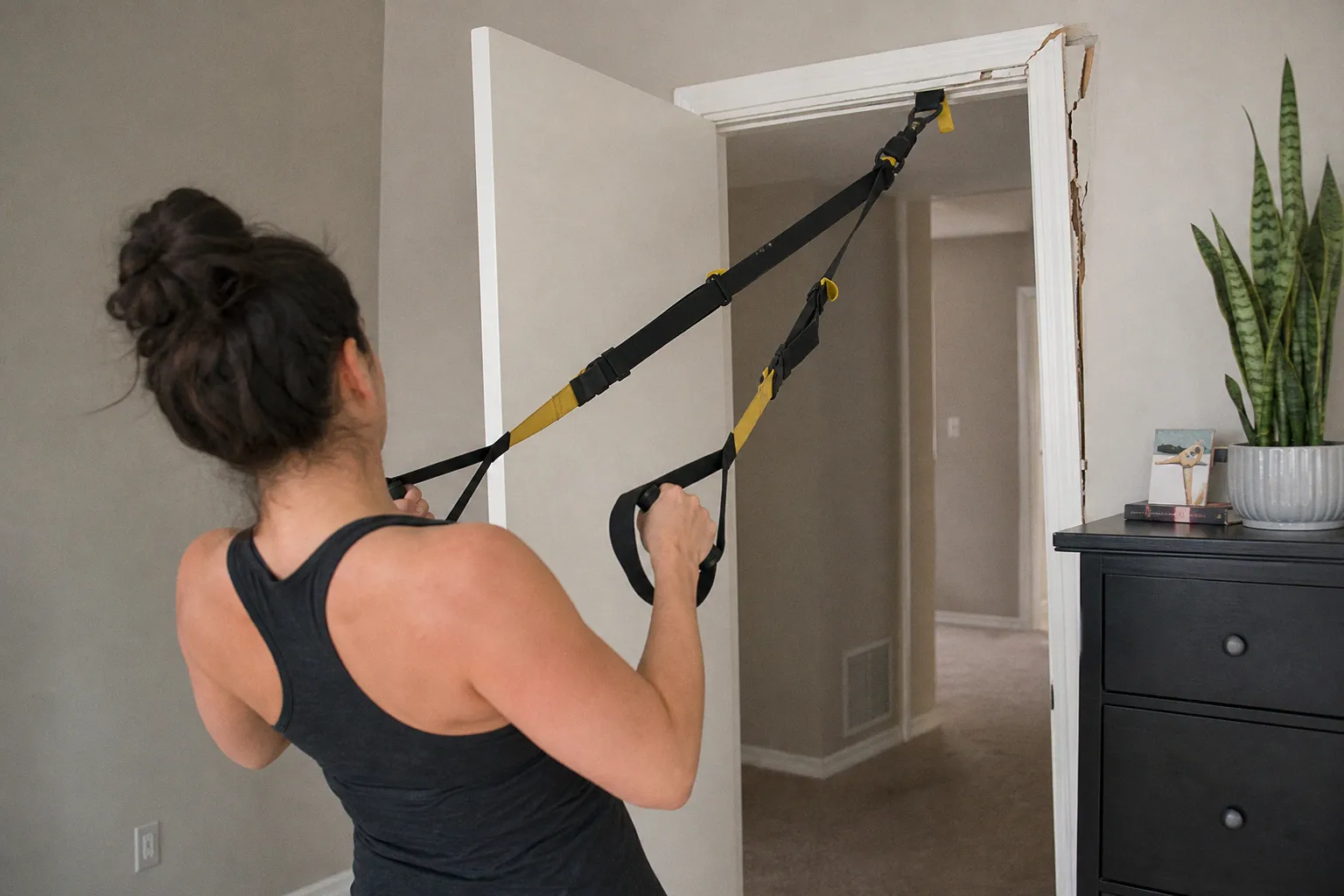
If you have no safe way to pull against resistance, do not simply ignore pulling. Prone floor movements, isometric towel rows, and carefully anchored bands can help, though a pull-up bar, rings, or a sturdy suspension trainer gives your upper back far more room to grow over time. The lats, mid-back, rear shoulders, and elbow flexors need resistance that asks them to shorten against load, not just wave around in the air.
A typical session might contain five or six movements, with two to four working sets each. You do not need to perform every possible variation in one workout. The body usually responds better when we can repeat a smaller menu with clean mechanics and a visible progression path.
The session should leave you worked, not structurally unravelled
There is a particular fatigue that tells us the target muscle has done meaningful work: the chest feels dense after a hard push-up set; the front thigh is warm and unsteady after controlled split squats; the upper back feels switched on after rows.
Then there is the fatigue that tells us the movement has lost its shape: pinching at the front of the shoulder, low-back compression during every bridge, wrist pain that sharpens from set to set, or a knee that caves inward because the foot and hip can no longer organize the load. We do not need to push through those signals. We need to adjust the variation, shorten the range temporarily if necessary, improve the setup, or reduce the amount of work.
That is not being fragile. It is how we keep training long enough for adaptation to accumulate.
Volume is where a plan stops being random
A full bodyweight workout plan does not need mathematical obsession, but it does need a way to count meaningful work. Current ACSM guidance describes roughly 10 weekly sets per muscle group as a practical hypertrophy target, with the essential word being roughly. It is a useful destination, not a rule carved into stone.
A beginner may grow well on fewer hard sets because almost every appropriately challenging set is new information for the body. A more experienced trainee may need more volume, more difficult variations, or added external resistance before the same muscles receive a meaningful signal again.
For home training, count a set only when the target area is genuinely doing the limiting. Ten sets of easy squats are not automatically ten useful quad sets. Ten sets of push-ups performed with sagging hips, half range, and elbows flaring into irritated shoulders are not ten useful chest sets either.
A more grounded weekly picture might look like this:
1. Chest, shoulders, and triceps: six to 10 challenging push-up-based sets across two or three days. Start with an incline if floor push-ups are too demanding; progress toward lower inclines, full push-ups, pause reps, feet elevation, or a loaded backpack.
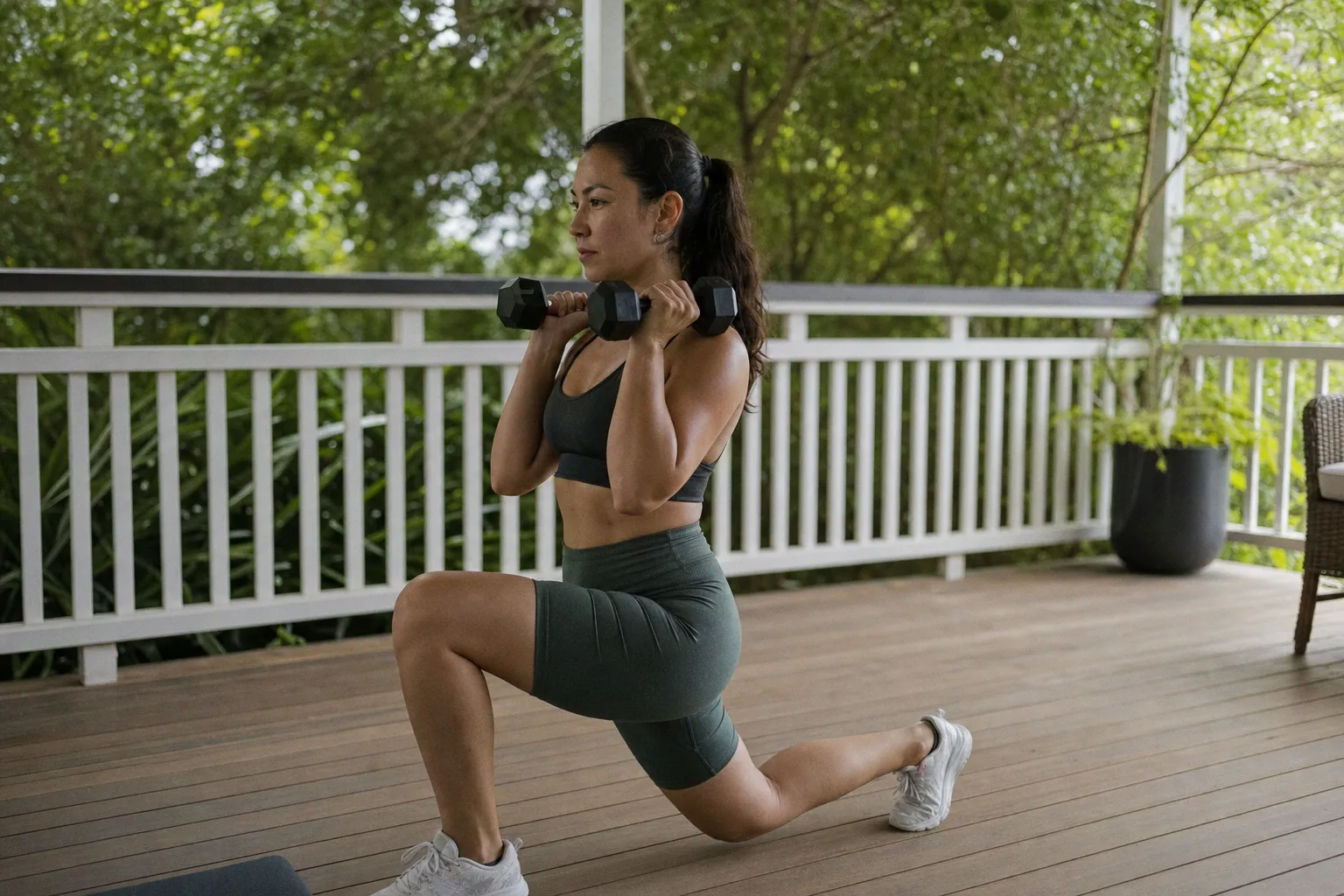
2. Quads and glutes: six to 12 sets from squats, split squats, step-ups, bridges, and single-leg bridge variations. Split squats are especially valuable at home because one leg absorbs more of your bodyweight without needing a heavier load.
3. Back and biceps: aim for repeated pulling exposure, ideally six to 10 progressively difficult sets each week. If bands or a bar are available, this is straightforward. Without them, prioritize isometric pulling and prone upper-back work, while recognizing that progression will be more limited.
4. Hamstrings and calves: bridges, sliding hamstring curls on a smooth floor, long-lever bridge variations, and slow calf raises keep the posterior chain from becoming an afterthought. The hamstrings cross both hip and knee, so they benefit from more than just a generic “leg day.”
5. Core stability: two to six sets of trunk work can be enough when the rest of training already demands bracing. Choose movements that teach the rib cage and pelvis to stay connected under tension: dead bugs, side planks, hollow holds, bear planks, and controlled carries if you have weights.
You do not need to take every set to the moment where a repetition physically cannot happen. The evidence does not show that momentary failure consistently produces better results for the average healthy adult. Instead, choose a variation and rep range that asks for concentration, then finish most sets with the sense that one to three well-controlled repetitions may still have been available.
That margin matters. It lets the fascia, tendons, and joint surfaces experience loading without every workout becoming a negotiation with exhaustion.
Progressive overload without heavy equipment is a skill
At home, progressive overload is less about adding a shiny plate every week and more about changing the problem your tissues have to solve. We can manipulate leverage, range of motion, tempo, stability, unilateral loading, and external resistance. These are not gimmicks; they are different ways of increasing the demand placed through a kinetic chain.
The order matters. Before progressing an exercise, make sure you can own its current version. A deeper squat is not progress if the feet collapse and the pelvis tucks under so aggressively that the hips lose their smooth, articulate movement. A harder push-up is not progress if the shoulder blades can no longer move cleanly across the rib cage.
Use this progression ladder:
1. Improve the range. Move from a partial squat to a comfortable, controlled depth. Let the chest approach the floor in a push-up without the head reaching first. A fuller usable range often creates more challenge before we need a new exercise.
2. Add repetitions within clean form. If you currently manage six strong push-ups, build toward 10 or 12. The last few should require real attention, but the body line and shoulder position should remain recognizable.
3. Slow the lowering phase. A three- to five-second descent increases time under tension and makes weak points obvious. In split squats, it also reveals whether the hip, knee, and foot are sharing load or simply collapsing toward the floor.
4. Add a pause at the hardest point. Pause one second near the bottom of a push-up, in the deepest stable point of a squat, or at the top of a glute bridge. This can melt away momentum and make a very ordinary exercise suddenly honest.
5. Change leverage. Elevate the feet for push-ups, move from two legs to one in a bridge, or lengthen the lever in a plank. Longer levers usually create more tension, but they also demand more trunk control.
6. Add modest load. A backpack filled gradually with books or water bottles can extend the life of squats, push-ups, bridges, and step-ups. Bands can add resistance where bodyweight alone no longer does. The load does not need to be dramatic; it needs to be stable, repeatable, and safe.
7. Add sets only after the exercise is challenging. More volume is useful, but adding endless easy sets is often less productive than making the existing sets more demanding.
Write down the variation, sets, repetitions, and one sentence about how the final set felt. That small record turns vague effort into a training process. If last Tuesday you performed three sets of eight incline push-ups from a kitchen counter, and today you complete three sets of 10 with the same form, you have evidence that the tissues are adapting.
Progress is not always heavier. Sometimes it is the same body moving with less compensation and more tension in exactly the place you intended.
The overlooked part of a full body calisthenics workout: mobility inside strength
Mobility is often treated as a separate, decorative activity: stretch for a few minutes, then return to “real” training. But the usable range of a joint changes the quality of the resistance work itself.
If the ankles cannot travel forward comfortably, a squat may tilt into the toes or fold the torso forward early. If the hip flexors feel gripped after hours of sitting, the pelvis may resist extending in a bridge, leaving the low back to create movement that the glutes should be producing. If the upper back is stiff and the shoulder blade cannot upwardly rotate and glide, overhead work and even push-ups can feel cramped at the front of the shoulder.
We do not need an hour of stretching before every session. We need a few minutes that prepare the regions we are asking to load.
Before a lower-body session, try:
- Slow ankle rocks, keeping the heel grounded while the knee travels over the middle toes.
- A half-kneeling hip-flexor position with a gentle glute squeeze, allowing the front of the hip to lengthen without arching the lower back.
- Supported deep squat holds, shifting softly from side to side and breathing into the back and sides of the rib cage.
- Controlled hip circles that make the hip joint move while the pelvis stays relatively quiet.
Before upper-body work, use:
- Scapular push-ups, where the elbows remain straight and the shoulder blades glide around the ribs.
- Wall slides or floor angels performed slowly enough to notice where the shoulders begin to pinch or lift.
- Gentle thoracic rotation from a quadruped position, letting the movement come through the upper back rather than cranking the low back.
- Wrist rocks, because the hands are load-bearing joints in nearly every push-up variation.
These are not magic drills. They are brief chances to give the nervous system a clearer map of the positions ahead. Over time, strength work itself becomes one of the most useful forms of mobility, because a joint that can control load through a range is usually more useful than a joint that can only be passively stretched there.
Protein supports the work, but it cannot replace it
Muscle is metabolically expensive tissue. If training provides the signal, food supplies some of the raw material for the repair and remodeling that follow. Protein matters, but the internet has made it easy to turn a practical nutrient into a daily source of anxiety.
A large review of protein supplementation alongside resistance training found that, in healthy adults, intakes above approximately 1.6 grams of protein per kilogram of bodyweight per day did not produce additional gains in fat-free mass from extra supplementation. That does not make 1.6 grams a compulsory target for every person, nor does it mean a higher intake is inherently harmful or pointless in every context. It simply gives us a useful ceiling for the idea that more shakes always mean more muscle.
For most people building a home routine, the more immediate question is whether protein appears consistently across the day. Eggs, Greek yogurt, tofu, beans, lentils, fish, chicken, lean meat, cottage cheese, tempeh, and protein-fortified foods can all play a role. Pair that with enough overall food to recover, carbohydrates that make training feel less flat, and fats that keep meals satisfying.
There is no need to make a post-workout meal dramatic. A normal meal containing protein within the broader rhythm of your day is usually far more sustainable than chasing a perfect ten-minute window while the rest of your intake is chaotic.
If you are managing an injury, chronic condition, pregnancy, disability, or symptoms such as chest pain, speak with an appropriate health professional before changing your exercise routine. The aim is to build capacity inside the reality of your body, not to borrow someone else’s template and force yourself into it.
Make the living room plan small enough to repeat
The most effective home programme is rarely the one with the most exercises. It is the one you can return to after a bad night’s sleep, a crowded week, a stiff day at the desk, or a session where the push-ups did not feel as smooth as they did last time.
Train the major patterns two or three times each week. Let the movements become more challenging gradually. Give the chest, back, legs, hips, and trunk enough honest work across the week. Eat in a way that supports recovery. And pay attention to where tension is being carried: in the intended muscle, or in a wrist, low back, neck, or joint that is trying to do somebody else’s job.
A simple daily integration helps more than people expect: after long sitting, stand up every hour or two for one minute of ankle rocks, a few slow bodyweight squats, and five scapular push-ups against a wall. It keeps the hips, rib cage, shoulder blades, and feet in conversation.
That conversation is the foundation. The stronger body follows from returning to it, patiently, one well-organized set at a time.