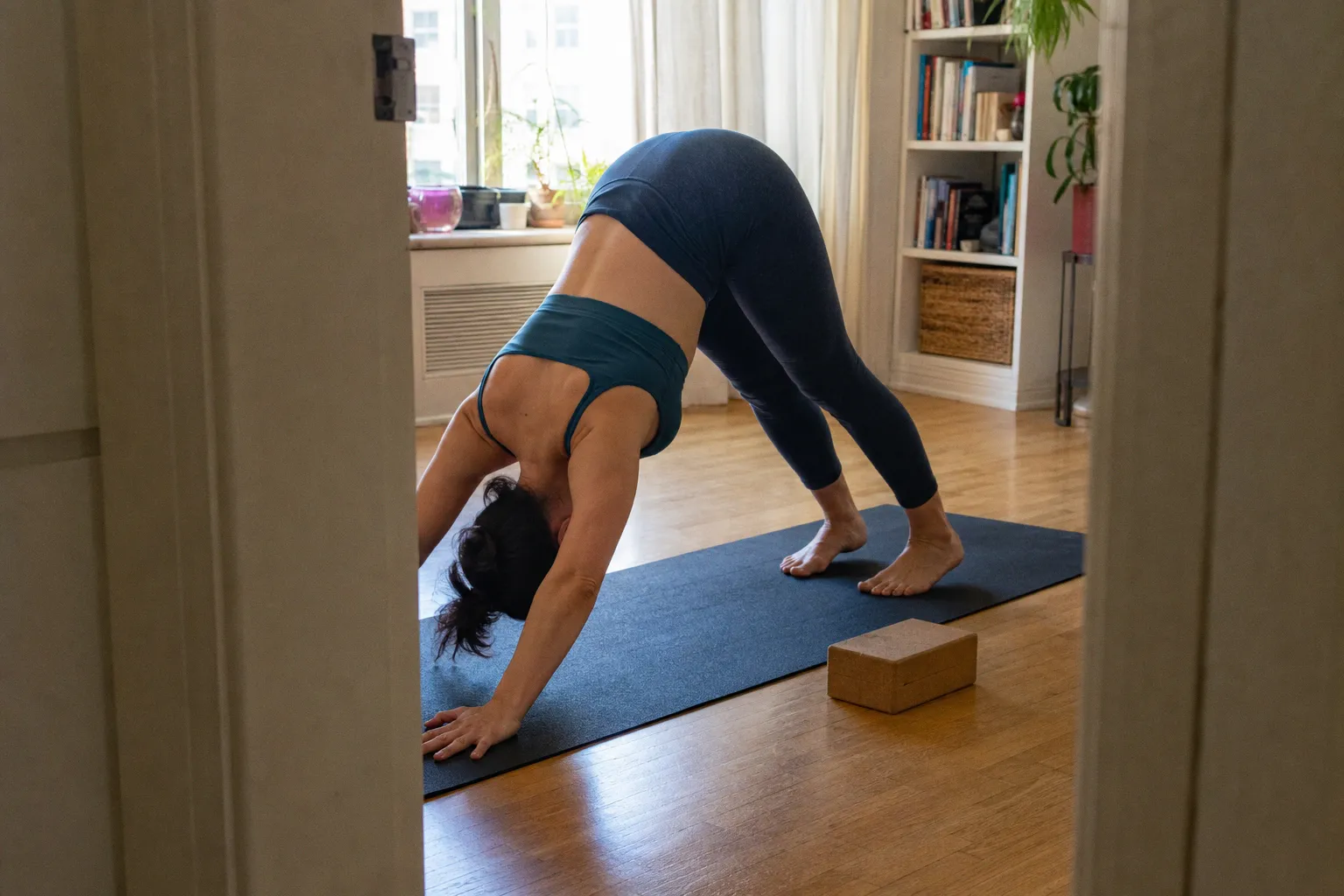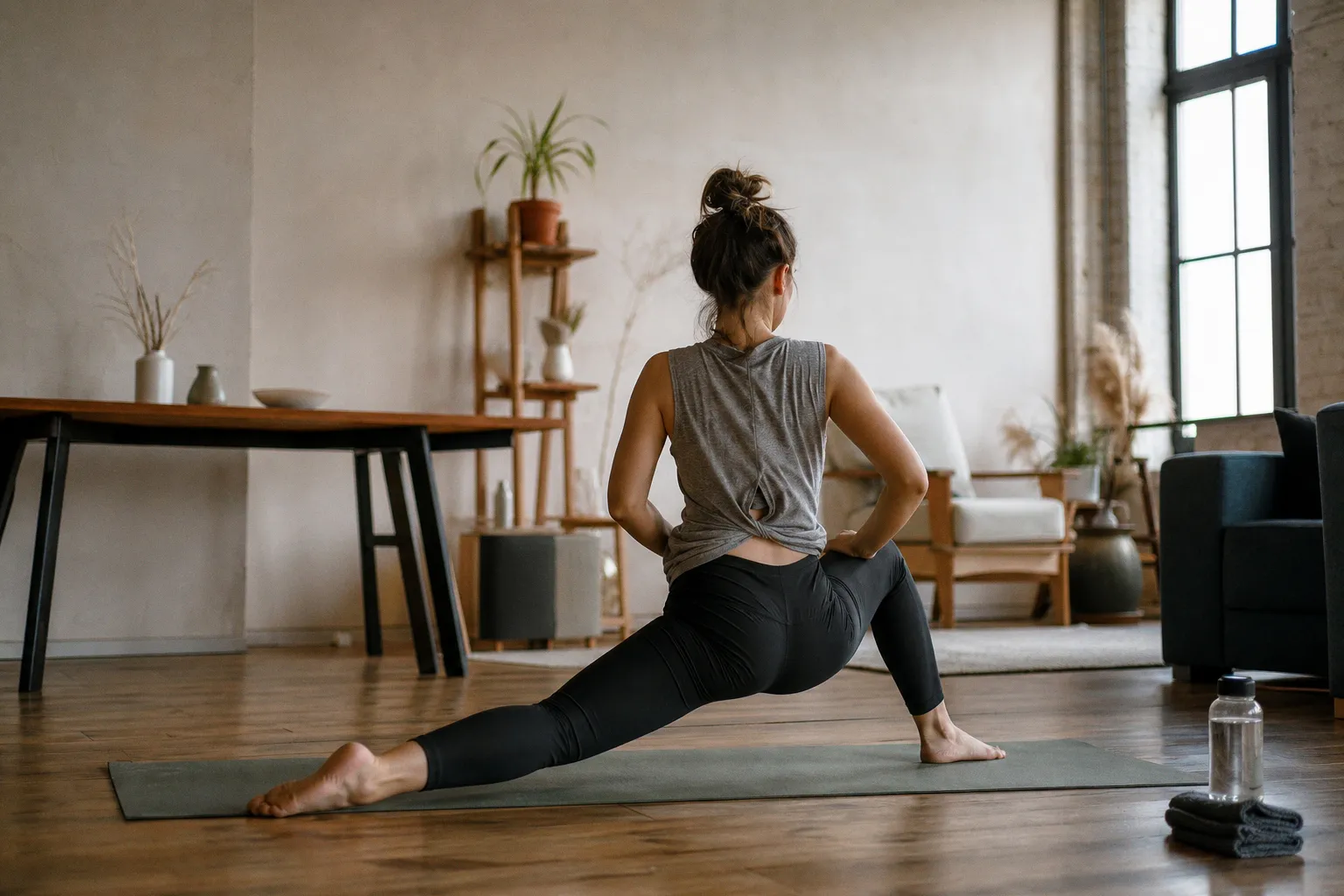
Most home stretchers cannot name a single number their routine changes. Range of motion in the hip? Untracked. Hold time per stretch? Anywhere from five seconds to two minutes, depending on mood.
After four weeks of consistent effort, most people cannot point to a measurable improvement in shoulder rotation, hip extension, or hamstring length. The American College of Sports Medicine publishes clear flexibility guidelines — 10 to 30 seconds per stretch, 2 to 3 days per week minimum — and almost no home practitioner follows them.
This is a full body stretching routine treated as a measurable training input. Not a wellness ritual, not a meditation, not a vibe. Five things you should know if you want actual mobility output, plus a 15 to 20 minute template you can run tonight.
Dynamic versus static: the timing problem that wrecks most routines
The single biggest mechanical error in any daily full body stretch is sequencing. Static stretching — holding a muscle in a lengthened position for a sustained period — temporarily reduces muscle power output if performed immediately before explosive activity. The research is consistent. Static holds before a sprint, jump, or heavy compound lift can drop force production by a measurable margin for roughly 15 to 30 minutes post-stretch, depending on hold duration and the muscle group involved.
Dynamic stretching, which moves a joint through its full range of motion actively, increases blood flow, elevates tissue temperature, and prepares the musculature for work without the power penalty. This is not a philosophical preference. It is a different physiological intervention with a different cost-benefit ratio.
The sequencing rule that actually holds up:
- Pre-workout, before any explosive movement: dynamic only. Leg swings, arm circles, hip openers through full range, controlled tempo work.
- Post-workout or on dedicated active recovery stretching days: static holds are appropriate. The muscle is warm, the nervous system is partially fatigued, and the cost of temporarily reduced power output is zero.
- Standalone mobility session: blend both. Move first to elevate tissue temperature, then transition into sustained holds.
Static stretching before a heavy lift is a performance penalty, not a primer. Move first, stretch after.
The reason sequencing matters specifically for a home fitness audience: many people execute a morning full body flexibility routine and then immediately start a HIIT session, sprint interval, or bodyweight circuit. If that is your pattern, swap the static holds for dynamic movements. It is a free 5 to 10 percent recovery of force output you are leaving on the floor. Stretch after the work, or on rest days, and the penalty disappears entirely.
Hold times: the 10–30 second window and the case for accumulating
The ACSM recommendation for static stretching is straightforward: 10 to 30 seconds per stretch, repeated 2 to 4 times per muscle group, performed at least 2 to 3 days per week. Defensible range. Backed by decades of flexibility research. Also the range most home practitioners ignore in favor of guesswork.
The mechanical logic is clean. A stretch held under 10 seconds does not provide enough tissue creep to produce meaningful lengthening in the muscle-tendon unit. A stretch held beyond 60 seconds begins to plateau in acute range-of-motion gains for most adults, though it may offer additional comfort and parasympathetic benefit. The 10 to 30 second band is the highest ROI window for time invested.
A refinement used in clinical and sports settings: accumulate 60 seconds total per muscle group across multiple shorter holds. Instead of one 45-second hamstring stretch, do three 20-second holds with brief rest between. The cumulative loading data suggests equal or superior flexibility outcomes, with less discomfort for tight populations and a lower risk of protective muscle spasm mid-hold.
| Parameter | Minimum effective | Optimal range | Diminishing returns |
|---|---|---|---|
| Hold per repetition | 10 sec | 15–30 sec | 60+ sec |
| Reps per muscle group | 2 | 3–4 | 5+ |
| Total accumulated time | 30 sec | 45–60 sec | 90+ sec |
| Sessions per week | 2 | 3–4 | 5+ (competes with strength work) |
Two sessions per week, with disciplined hold times, produces measurable flexibility gains in most untrained adults within 4 to 6 weeks. Three to four sessions accelerates the curve. Five or more sessions per week provides diminishing flexibility returns and begins to compete with actual strength and conditioning time. Pick a frequency you can sustain for a quarter, not a week.
Breathing: not a wellness accessory, a mechanical input
Breathing during stretching is often framed as a mindfulness tool. The mechanism is more specific than that. Slow, deep exhalation during a stretch activates the parasympathetic branch of the autonomic nervous system, which reduces protective muscular tension. A muscle held in chronic low-grade guarding — the typical state for desk workers, runners, and anyone with hip flexor or upper trap tightness — will physically resist lengthening until that guarding signal is downregulated. Controlled exhales during the deepest part of the hold are how you bypass it.
The protocol, simple and repeatable:
1. Inhale through the nose for 3 to 4 seconds as you move into the stretch.
2. Pause briefly at end range.
3. Exhale through the mouth for 5 to 7 seconds, allowing the muscle to lengthen further.
4. Repeat for the duration of the hold.
The exhale is the active phase. The inhale is setup. Most people do the opposite — they inhale into the hardest position and exhale as they release. Reverse it. The stretch response is measurable within a few breath cycles. Tissue that felt like a steel cable on the first exhale often softens by the third or fourth. This is not breathwork for its own sake. It is a mechanical input that changes the stretch outcome in real time. Treating it as an optional wellness layer is the fastest way to waste your time on a full body flexibility routine.
If your stretch routine produces no measurable change in hip or shoulder range of motion after four weeks, you are not stretching — you are posing.
Joint mobility versus traditional stretching: a critical distinction
A stretching exercises for beginners program often blurs two distinct mechanical inputs. Traditional stretching loads a muscle in a lengthened position and holds it. Joint mobility exercises move a joint through its full range of motion actively, using the surrounding musculature to control the movement. The training outcomes are not the same.
Mobility work develops active range of motion — the range you can control under tension, on your own. Static stretching, performed in isolation, develops primarily passive range of motion — the range an external force (gravity, a strap, a partner) can take you to. Active range is more functional. Passive range, beyond what you can actively control, is largely cosmetic and offers little transfer to athletic output or daily movement.
A full body stretching routine built entirely around static holds produces mostly passive gains. Add controlled articular rotations — hip CARs (Controlled Articular Rotations), shoulder CARs, ankle circles, thoracic spine openers — and you convert some of that passive range into active control. This is the difference between being able to sit in a deep squat for 30 seconds and being able to stand up from a deep squat under load, repeatedly, without compensation through the lower back.
For beginners, sequence matters: prioritize joint mobility drills at the start of a session, then transition into static holds once tissues are warm and the nervous system is primed to allow deeper positioning. Skip this order and you spend the first half of every static hold fighting protective reflexes. The mobility work is the on-ramp. The static holds are the destination.
A 15 to 20 minute home template that produces measurable output
Here is a structured full body stretching routine you can run three to four times per week, scaled for a home fitness audience with no equipment. The structure: mobility primer, dynamic flow, static holds with breath protocol, brief reassessment.
| Phase | Duration | Type | Example movements |
|---|---|---|---|
| Mobility primer | 3–4 min | Active joint rotations | Hip CARs (5 each side), shoulder CARs (5 each side), ankle circles, thoracic rotations |
| Dynamic flow | 4–5 min | Moving stretches | World's greatest stretch, leg swings (front-back and lateral), arm circles, cat-cow |
| Static holds | 8–10 min | Sustained lengthening | Hamstring (3 × 20 sec), hip flexor lunge (3 × 20 sec each side), chest doorway stretch (3 × 20 sec), lat hang (3 × 20 sec each side), supine piriformis (3 × 20 sec each side), standing calf (3 × 20 sec each side), standing quad (3 × 20 sec each side) |
| Reassessment | 1 min | Self-test | Toe touch distance, deep squat hold, overhead reach — record range |
Total time: 15 to 20 minutes. Three to four sessions weekly meets or exceeds the ACSM minimum frequency for flexibility training. The reassessment phase is what most routines omit, and it is the part that converts a flexibility practice into a measurable one. If your toe touch distance or overhead reach has not changed in four weeks, you have data. Adjust the routine — more frequency, longer holds, or better breathing — and retest.
Three execution rules that improve results without adding time:
- Order: large muscle groups first, smaller groups second. Hip flexors before quads. Hamstrings before calves. The body opens in layers; respect the sequence.
- Position over duration: a clean 15-second hamstring stretch with a posteriorly tilted pelvis produces more change than a sloppy 45-second version with a rounded back. Form is a force multiplier.
- Consistency over intensity: a 15-minute session three times weekly outperforms a 45-minute session once weekly for almost every flexibility metric that matters. Recovery is cumulative, not heroic.
The verdict: do this if you can measure it, skip it if you can't
A daily full body stretch is a real training input with a clear cost-benefit profile. Cost: 15 to 20 minutes, 3 to 4 days per week, sustained attention to breathing, position, and sequencing. Benefit: measurable improvements in passive and active range of motion within 4 to 6 weeks, better movement quality under load, faster recovery between sessions, and reduced compensatory strain in the lower back, neck, and shoulders.
The same routine performed casually — five-second holds, no breathing protocol, no mobility primer, no ROM tracking — produces almost nothing. Same time investment, near-zero output. This is why most people who "stretch every day" report no change. They are not training flexibility. They are going through a motion.
Do this routine if you can commit to three sessions per week, track one range-of-motion metric, and breathe properly into the holds. Skip the ritual version. The body does not respond to good intentions. It responds to mechanical input, applied consistently, over time.