Six-thirty in the morning. Your shoulder still holds yesterday's overhead press, your hip flexors haven't opened up from sitting, and the body's recovery clock has started ticking long before you have spoken a full sentence.
Smoothie High Protein Recipes: The Two-Minute Architecture That Holds Your Mornings Together
The freezer is the connective tissue between aspiration and execution. Two minutes of morning work rests on thirty seconds of Sunday architecture.
The Two-Minute Prep Strategy: Building Freezer Packs That Do the Heavy Lifting
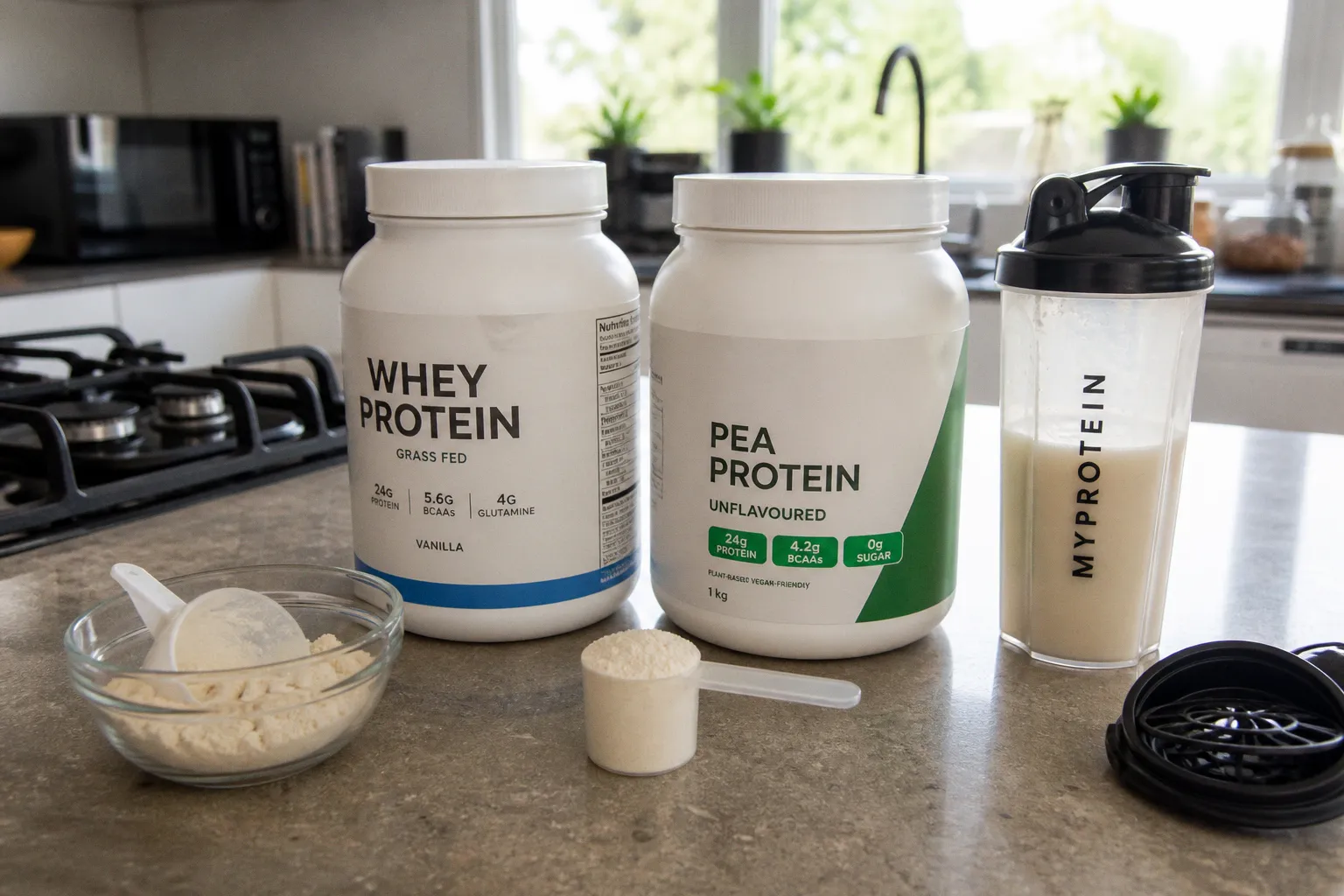
The reason most smoothie high protein recipes quietly fail is not the recipe itself — it is the choreography. We stand at the counter hunting for the protein powder, opening and closing the freezer, slicing a banana, rinsing the blender, and by the time the blades start, four minutes have passed and so has the small window of appetite we woke up with. A freezer pack changes the architecture entirely.
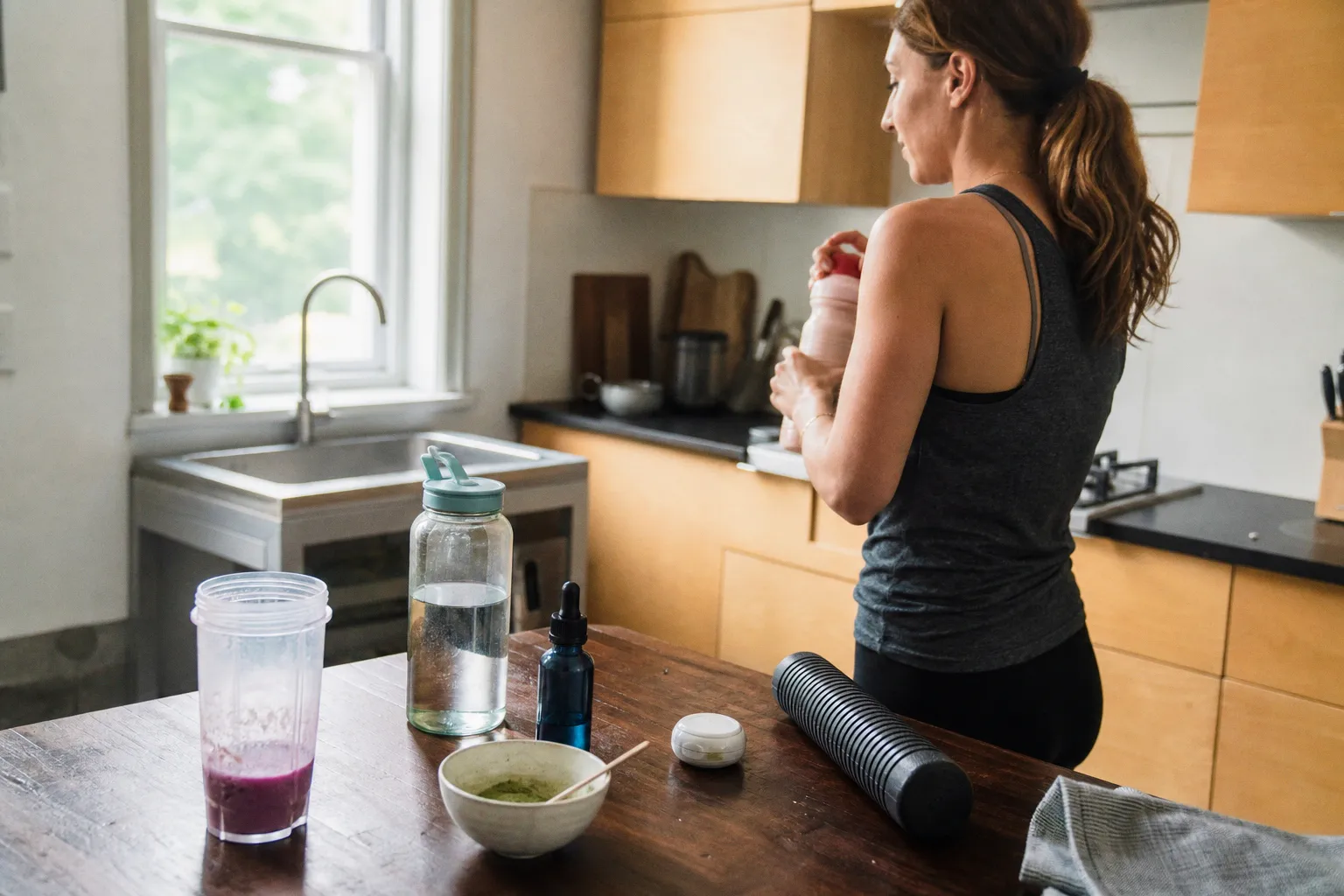
The premise is straightforward. On a Sunday, when we have fifteen minutes and a square of counter space, we measure our dry and frozen ingredients into individual reusable silicone zip bags or freezer-safe bags, label them by flavor, and stack them flat in the freezer. When morning comes, we tip a single bag into the blender, add the liquids — almond milk, coconut milk, water, whichever the recipe calls for — and we are genuinely done in roughly sixty seconds of blend time, plus the rinse. The active prep from cold kitchen to pourable glass sits right around two minutes total.
What we are really doing is moving the decision fatigue out of the morning and freezing it into a structure we already trust. For a Classic Strawberry Banana pack, that means tossing in frozen strawberries, half a sliced banana, a tablespoon of chia seeds, and a single scoop of protein powder. When the bag hits the blender with almond milk and a small drizzle of honey, we land around twenty-two grams of protein in roughly two minutes of active work — and we did not have to think for a single one of those minutes about what we were making.
The same architecture works for a Coconut Creamsicle pack: a wedge of orange, half a banana, vanilla extract, a touch of maple syrup, and ice in the bag; coconut milk and water added at the blender gets us roughly twenty grams of protein. The pack format is what gives these quick high protein smoothie recipes their reproducibility; the morning becomes reflexive instead of chaotic.
Blender-Free Hacks: When the Blender Is Not Even in the Room
There is a second tier of this architecture, and it matters for the days when we are not standing in our own kitchen. Travel days, gym-bag days, the small training corner with no outlet in sight — these are the moments our freezer-pack idea quietly upgrades into something more mobile.
The blender-free trick is to take the already-blended smoothie and freeze it in silicone ice cube trays. Each cube becomes a concentrated, pre-measured portion of the final drink. To serve, we drop four or five cubes into a shaker cup or a wide-mouthed jar, add the liquid of choice, and let them sit for fifteen to twenty minutes to thaw enough that we can shake them into a drinkable consistency. This is the only honest disclaimer worth naming out loud: the texture will not match a high-speed blender on fibrous greens like kale, but for fruit-forward and creamy profiles — strawberry banana, chocolate peanut butter, coconut creamsicle — the shake lands clean and pourable.
Commercial versions confirm the model. Evive's Yogi Protein & Superfoods cubes, for instance, deliver about eleven grams of protein per 150-gram serving and follow essentially this protocol: drop the cube, add liquid, wait roughly twenty minutes, shake vigorously. The homemade version saves money, lets us choose the protein powder we are using, and lets us dial the macro split to whatever our training week actually requires.
Two minutes is not a shortcut. It is a structural decision about how we want our mornings to feel — and a small architectural move that keeps recovery from being the thing that gets quietly skipped.
High-Protein Flavor Profiles: From Strawberry Banana to Zucchini Supreme
The pack architecture opens the door to a real range, and the differences matter more than they look. Some flavor profiles reward a long, cold blend; others collapse in on themselves if we over-blend. Knowing which is which is part of how we develop a smoothie practice that does not bore us into abandoning it by week three.
Here is how the four core templates in this family land against each other. The protein numbers are approximate and reflect a single serving made the way the recipes are written; doubling the protein powder is the easiest way to push any of these higher if our training load has climbed.
| Recipe | Prep Time | Protein / Serving | Key Ingredients | Best For |
|---|---|---|---|---|
| Classic Strawberry Banana | 2 minutes | ~22g | Frozen strawberries, banana, almond milk, chia seeds, honey, protein powder | Daily driver, post-cardio recovery |
| Coconut Creamsicle | 2 minutes | ~20g | Coconut milk, water, vanilla, maple syrup, orange, banana, ice, protein powder | Hot mornings, citrus cravings |
| Chocolate Peanut Butter Banana | 3 minutes | ~26g | Banana, almond milk, peanut butter, PB2, protein powder, cacao, ice | Post-strength training, long satiety |
| Chia Zucchini Protein Supreme | 4 minutes | ~28g | Fresh zucchini, turmeric, almond butter, chia, vanilla plant protein, cinnamon, ice, almond milk | Highest macro density, anti-inflammatory focus |
The Strawberry Banana and the Coconut Creamsicle are the two-minute archetypes — the ones we can confidently promise will land inside the window even on the most rushed morning. The Chocolate Peanut Butter Banana is the satiety champion: the combination of real peanut butter and PB2 gives us a layered fat-and-protein profile that holds hunger off until a real meal. And the Chia Zucchini Protein Supreme is the heavyweight: twenty-eight grams of protein, fresh zucchini blending nearly invisibly into the base, turmeric and cinnamon doing their quiet anti-inflammatory work in the background. It bumps prep time up to about four minutes because we are grating or chopping the zucchini, but a freezer-pack version of the green blend — assembled with the zucchini already shredded and pre-measured — brings it back to two and a half.
The texture distinction is worth pausing on. Creamy recipes like the Coconut Creamsicle or the Chocolate Peanut Butter Banana melt into a unified, almost milkshake-like body that forgives small variations in blend time. The Chia Zucchini Supreme is more particulate — chia and shredded zucchini carry structure, and we want to honor that by giving the blender an extra few seconds. This is the part of the practice where we begin to read the recipe by feel instead of by clock.
Safety and Storage: Headspace, Glass, and How Long These Packs Actually Last
We have a bias toward glass in our kitchen because glass does not hold onto the previous night's garlic or the faint vanilla of last week's protein shake. Glass also cracks in the freezer if we treat it wrong, and that matters here because the most beautiful freezer smoothie of the morning is the one the jar actually survives until lunch.
Liquids expand by roughly nine percent when they freeze. That number is small enough to ignore — until a jar in the back of the freezer quietly splits at the shoulder at two in the morning and ruins the chickpeas we were saving for soup. When we pour fully blended liquid smoothies into glass jars for storage, we leave at least half an inch of headspace at the top. We also confirm the jar is specifically labeled freezer-safe before we trust it for this work — not all glass carries that rating. A standard mason jar that has not been tested for freezer use is asking for trouble: once a blended smoothie freezes and the liquid expands, the shoulder of the jar can crack, and we lose the entire batch along with whatever was stacked next to it. Jars marked freezer-safe are built to handle that expansion, but only when we honor the headspace the manufacturer specifies.
For the freezer packs themselves — the dry-and-frozen ingredient bags — the question is shelf life, and the answer depends on whether specific greens or delicate ingredients are involved. Pre-portioned fruit-and-protein packs stored in reusable silicone zip bags or freezer-safe bags stay good for up to three months. Green protein packs, particularly those built around spinach or other delicate leafy bases, are best used within roughly five months to keep flavor and color from drifting. We label every bag with the date it was made and rotate from the front of the stack.
One quiet note on nutrient stability worth being honest about: freezing does not fully stop oxidation, it only slows it. Across several months in the freezer, vitamins degrade a small but real amount. The honest framing is that freezer packs are not a permanent food supply; they are a two-to-three-month convenience layer that lets us put protein into our bodies during the windows when our muscles are actually listening for it.
Optimizing Texture and Nutrient Density Without a High-Speed Blender
The blender-free cube method works because of how the recipe is engineered, and that is the part worth understanding on its own. We are not asking the shaker cup to break down raw kale or to emulsify a tablespoon of almond butter from scratch. We are giving it pre-blended material that simply needs to thaw and redistribute. The texture will be slightly looser and slightly less aerated than a high-speed blend, but the macro split, the protein content, and the fiber breakdown are essentially identical.
There are two honest limitations worth naming. First, fibrous greens like kale do not fully break down in a shaker, even after a full twenty-minute thaw — we will get small flecks, and that is fine, but if our goal is a perfectly smooth green smoothie with no plant matter visible, the blender is the right tool. Second, very thick mixes built around nut butter or frozen banana can resist the shaker and want to cling to the cubes; a small splash of extra liquid at the start and a slightly longer thaw prevent the chunky bottom-of-the-cup result.
For fiber and nutrient density, the structural moves that help most are small: keeping the skin on the zucchini, leaving the chia whole rather than ground, and freezing the banana just before full ripeness. A fully ripe banana freezes beautifully, but a banana frozen slightly earlier holds more resistant starch, which behaves differently in the gut and supports satiety differently during a heavy training block. Small structural decisions, made once on prep day, change the way a smoothie lands on a Tuesday morning three weeks from now.
The two-minute smoothie is not a culinary trick. It is a recovery scaffold — a quiet way to keep showing up for the work we have already asked our tissues to do.
Putting It Together: A Sunday That Pays You Back All Week
Here is the realistic weekly rhythm. Sunday afternoon, when the kitchen is already active and we are already cleaning, we set out six silicone zip bags, a marker, and the four recipes above — two strawberry banana, one coconut creamsicle, one chocolate peanut butter banana, one chia zucchini supreme, and one open slot for whatever flavor profile the week is asking for. We portion, label, date, and stack flat in the freezer. That investment is roughly twenty-five minutes, done once.
Each morning for the next three weeks, we pull one bag, add liquids, and blend for sixty seconds — or, on the days we are leaving the house without a blender, we pull pre-blended cubes from the freezer into a shaker the night before and let them thaw in the fridge overnight, ready to shake and go at six-thirty. The morning kitchen stays quiet. The recovery window stays fed. The fascia keeps gliding, the joints keep articulating, and we keep showing up for the next training block without our nutrition quietly falling apart around us.
The two-minute smoothie is not really about the smoothie. It is about the structural decision to make recovery the easiest thing in the room — instead of the thing we have to fight for at six-thirty in the morning, half-awake, with a sore shoulder and a hip flexor that has not opened up yet, and a body that is quietly asking for exactly what we have already prepared.