Mass-Market Functional Fitness
If your hips feel stiff after a desk-heavy day and your first squat of the evening lands like a creaky hinge, the phrase “functional fitness” suddenly becomes more than a market label.
A fresh cluster of industry items is pointing toward mass-market functional fitness: Trend Hunter has flagged the term directly, openPR is carrying a broader analysis of health and fitness club market segments and competitors, and IndexBox is tracking a niche slice of exercise equipment around twist-waist devices in Russia.
For home-training people, the useful part is not the buzzword itself, but the direction of travel: fitness products, clubs, and equipment categories are still being packaged around movement that feels practical, body-wide, and easy to sell to everyday exercisers.
The label is getting bigger — but your body still needs specifics
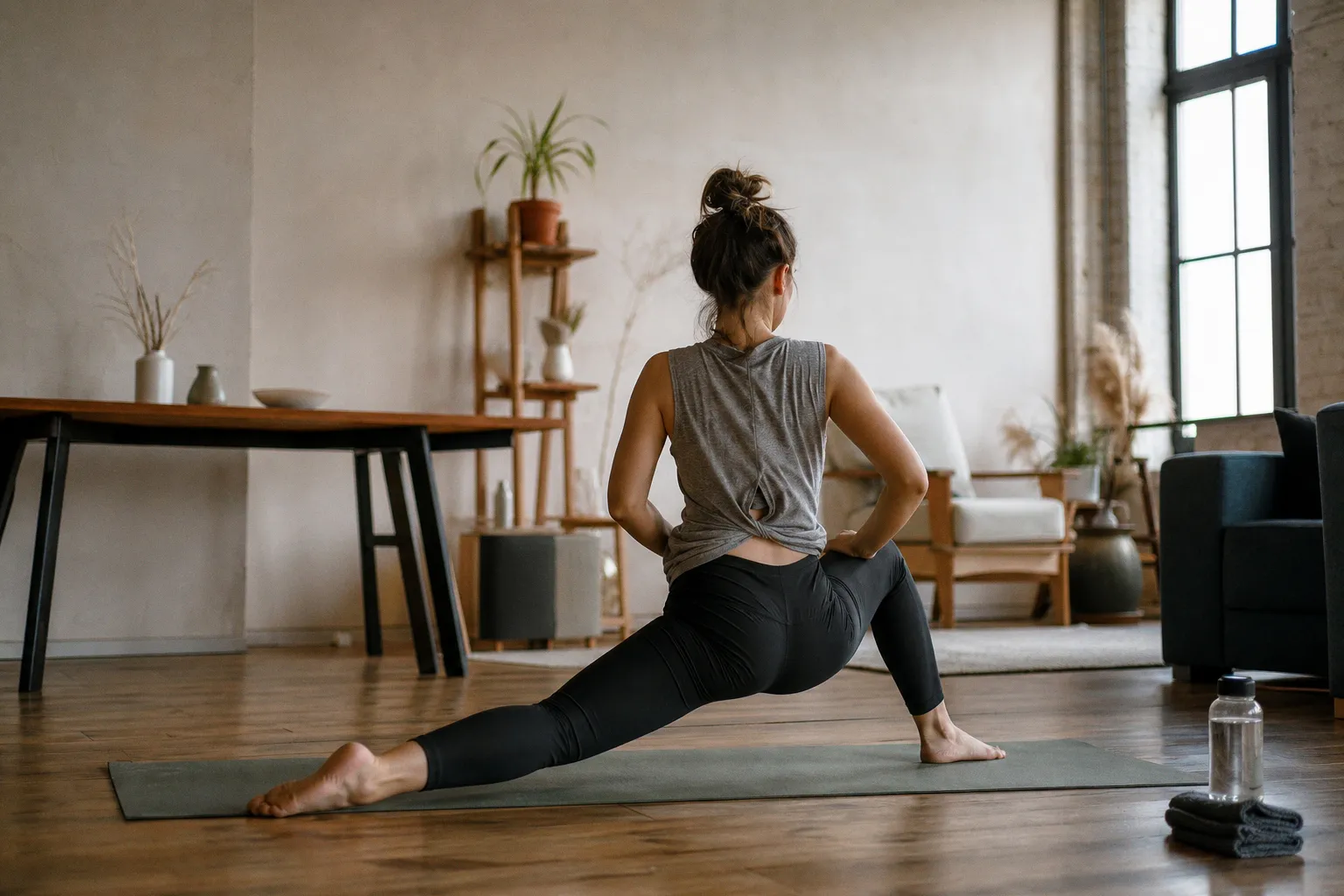
“Mass-market functional fitness” sounds neat on a trend board, but in the living room it has to become something more tactile: can you hinge without your low back gripping, rotate without yanking through the ribs, and step, squat, push, pull, or brace with enough control that the whole kinetic chain participates?
That is the quiet tension in this kind of market story. When functional fitness moves into the mainstream, the language often becomes broad enough to fit almost anything: club programming, at-home accessories, compact cardio formats, bodyweight circuits, or small equipment built around the waist and trunk. The sources here do not give detailed numbers or product claims, so we should not pretend there is a clean scoreboard. What they do show is a familiar pattern: “functional” remains a valuable word in the fitness economy.
For us, that means reading the label with a practitioner’s eye. A workout is not functional because it looks athletic on a thumbnail; it earns that description when it helps your joints articulate better, your fascia tolerate load more smoothly, and your nervous system coordinate effort without turning every rep into a full-body clench.
Clubs, equipment, and the home-workout crossover
The openPR item is framed around segments, industry trends, and major competitors in the health and fitness club market. IndexBox, separately, points to market analysis and forecasts for Russia twist-waist exercise equipment. Trend Hunter’s listing uses the direct phrase “Mass-Market Functional Fitness.”
Taken together, carefully, these are not proof of one single boom or one miracle category. They are a reminder that functional training is being discussed across very different commercial spaces: club businesses, trend reporting, and equipment analysis.
That matters if you train without a gym membership, because mass-market fitness tends to travel quickly into home routines. A club-floor idea becomes a short HIIT block. A mobility class becomes a streaming session. A compact device becomes a corner-of-the-room promise. Some of that can be genuinely helpful; some of it can flatten complex movement into one repetitive pattern.
Twist-style waist equipment is a good example of where we need calm biomechanics, not hype. Rotation is part of healthy movement, but the trunk is not just a waistline to be wrung out like a towel. Your ribs, pelvis, spine, hips, and deep abdominal wall share the work. If a movement makes you brace hard through the jaw, jam the low back, or chase speed while your feet and hips stay disconnected, the “functional” part has already started to melt away.
What to watch before you buy into the trend
The practical filter is simple: look for training that teaches transfer, not just fatigue.
A useful functional session at home should give you a little more access to daily movement — standing from the floor, carrying groceries, climbing stairs, reaching overhead, rotating to pick something up — without asking you to push past sharp discomfort or sacrifice joint position for intensity. In HIIT terms, that might mean fewer frantic combinations and more clean patterns: squats that let the ankles and hips share range, lunges that keep the pelvis steady, push-ups that let the shoulder blades glide, and core work that resists motion as well as creates it.
The market may keep stretching the phrase “functional fitness” because it is friendly, flexible, and easy to understand. Our job is to bring it back into the body. Before adding a new class format or piece of equipment, ask what it helps you feel: more controlled rotation, smoother hip flexion, better balance, easier breathing under effort, or simply more noise and tension.
A realistic daily integration tip: after your next home workout, take two slow minutes to test one pattern you actually use in life — a deep sit, a reach, a step-back lunge, or a gentle trunk rotation. If it feels more spacious and coordinated than when you began, the session served you. If everything feels tighter and louder, the trend can wait while your tissues get a smarter dose.