Mobility Exercises: The 3-Minute Wall Hack…
The mid-back is a region most of us feel before we understand it. That stiff, locked-down band between the shoulder blades, the one that creaks when you twist to shoulder-check in the car, the one that makes reaching the top shelf feel like an athletic event — that's the thoracic spine asking for attention, and it has been asking for a while.
The Mechanics of the Mid-Back: Why Your Thoracic Spine Gets Stuck
The thoracic spine is the twelve-vertebrae middle section of your back, running from just below the neck down to the small of your lower back. It's the only spinal region directly attached to the rib cage, which means every breath you take, every twist you make, every time you reach overhead, this segment is involved. It is also the segment most people have trained, through years of sitting, scrolling, and slouching, to do almost nothing.
When we sit for long stretches, the thoracic spine rounds forward, the shoulders roll inward, and the chest literally collapses. The muscles of the upper back — the lower trapezius, the mid-scapular stabilizers, the small rotators that articulate each vertebra against the next — lengthen into a weakened state, while the chest muscles shorten and tighten. Over time, the joints themselves adapt to this rounded position. The articular cartilage at the facet joints compresses on the back side, the costovertebral joints where ribs meet spine stiffen up, and the fascia that wraps the whole region becomes what it has been: a stuck, matted sheet that no longer glides.
The result is a mid-back that no longer rotates, no longer extends, and no longer lets the shoulders sit where they are supposed to sit. The neck and lower back then try to pick up the slack, which is why a stiff thoracic spine so often shows up as neck pain, lower back pain, and shoulders that hang forward like they're trying to leave the body.
Wall Angels: Mastering the Three-Point Contact Technique
The simplest, most direct way to reintroduce movement into the thoracic spine is the Wall Angel. It's a drill that strips the upper back down to its essentials and forces it to move against a flat surface, which is exactly the feedback the body needs to relearn the position it has been avoiding.
Stand with your back to a wall. Place your feet about six inches away from the baseboard, knees soft. Now press three points into the wall: the back of your head, your upper back between the shoulder blades, and your tailbone. Your lower back should not be touching the wall — there should be a small, natural space behind your lumbar spine. Settle into this contact, and you will feel the entire chain of posture click into place.
From here, bring your arms up into a goalpost position, elbows bent at ninety degrees, the backs of the hands and the elbows themselves pressed into the wall. Slowly slide the arms up the wall, keeping every contact point honest — your head, your upper back, your sacrum, and your elbows all kissing the surface. As the arms go overhead, the upper back will arch slightly — that's the thoracic spine articulating. Then reverse the path, lowering the arms back down with the same control.
The wall is a mirror for your spine. If a contact point breaks, your body is telling you — in real time — exactly where the stiffness lives.
A standard prescription is two to three sets of eight to twelve slow repetitions, breathing in on the way up and out on the way down. The exercise is meant to be felt, not hurried. The first set will likely reveal just how much mobility has been lost; the third set is where the upper back begins to remember what it used to do.
The Yoga Block Trick for Precise Thoracic Rotations
The thoracic spine is built to rotate, and yet rotation is the very direction most stiff mid-backs cannot access. The Thoracic Wall Sweep is a half-kneeling drill that reopens this rotation, and it works beautifully when paired with a small piece of equipment most of us already have at home: a yoga block, a foam roller, or even a thick paperback shoved into the right place.
Set up in a half-kneeling position next to a wall, with the inside knee down and the outside foot planted, both legs at ninety degrees. Place a yoga block between the inside knee and the wall. This is the trick: the block stabilizes the pelvis and prevents the hip from swaying forward when the torso rotates. Without it, the hip tends to take over the rotation, and the thoracic spine gets cheated out of the very movement it needs.
Once the pelvis is locked, place both hands lightly behind the head, elbows wide. Rotate the chest away from the wall, hinging forward slightly so the upper back rounds into flexion, then sweep the chest back toward the wall, opening the elbows wide and arching the upper back into extension. The motion is a single, fluid arc — flexion with rotation, then extension with rotation — sweeping from one end-range to the other.
The block keeps the lower body out of the discussion. The thoracic spine, finally, has nowhere to hide. The costovertebral joints begin to articulate, the facet joints open and close, and the fascia that wraps the ribs starts to lengthen in the direction it was originally designed to move.
Targeting Extension: Elbow Slides and Wall-Based Stretches
While rotation is half the story, extension is the other half — and for most people, it is the more urgent half. The Wall Thoracic Extension drill loads the mid-back with a sustained, gentle stretch that pulls the thoracic spine out of its rounded posture and into the opposite shape.
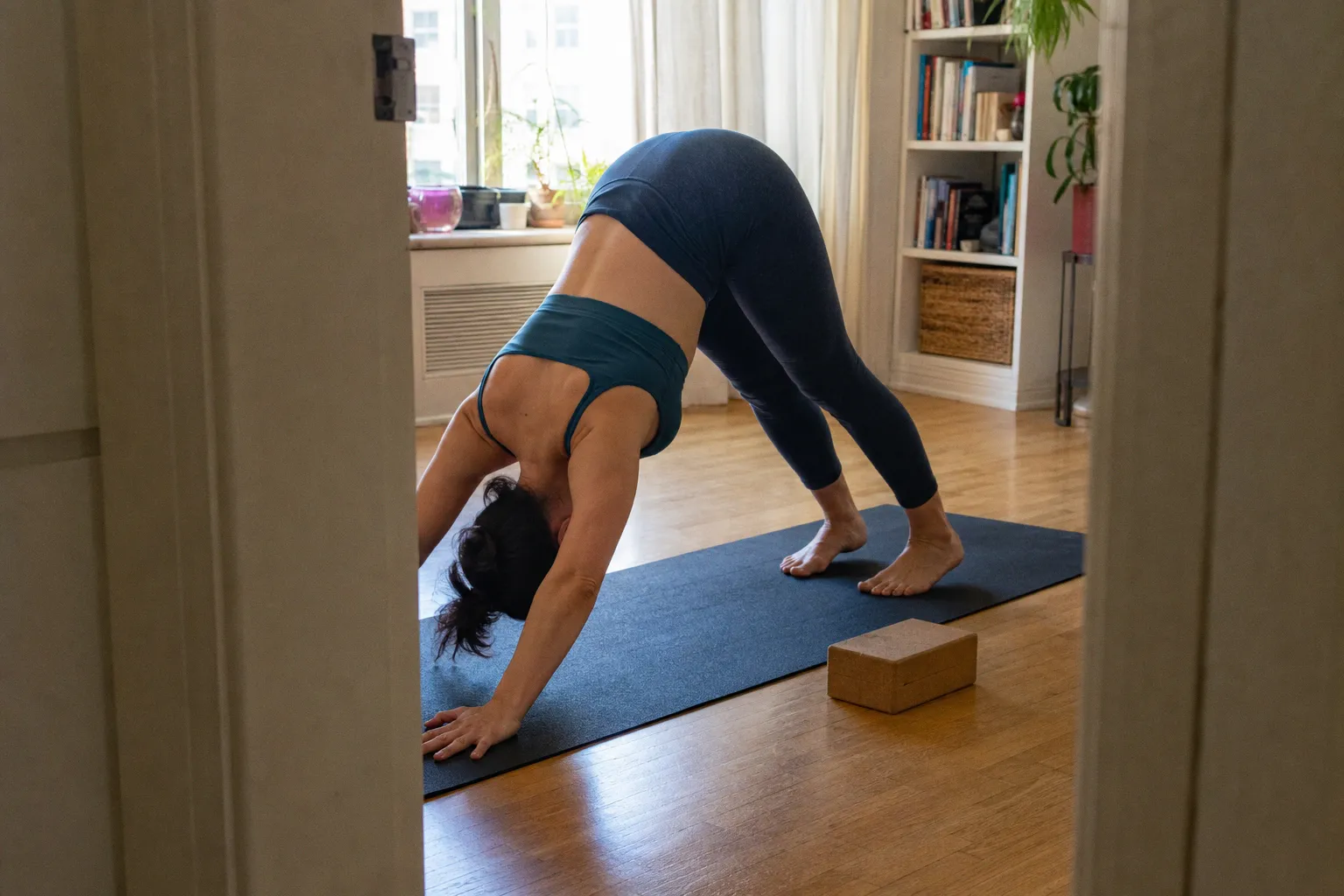
Stand at arm's length from a wall, feet hip-width apart, and place both hands flat on the wall at shoulder height. Slowly push the hips back as if reaching for a wall behind you, and let the chest sink toward the floor. The arms stay long, the hands press into the wall, and the upper back begins to round, then drop, then open into a deep thoracic extension. Hold the position at the deepest comfortable point for around two minutes, breathing slowly into the rib cage, allowing each exhale to soften the front of the chest and the abdominal fascia.
For a more dynamic version, the Thoracic Extension Elbow Slide is a brilliant option. Stand facing the wall, hands at shoulder height, elbows bent. Tuck the pelvis under by softening the knees and tipping the tailbone forward — this is the second trick, and it takes the lumbar spine out of the movement. With the lower back locked into neutrality, slide the elbows up the wall, hold at the top for around ten seconds, and lower back down. The thoracic spine is forced to extend without the lower back's help, which is exactly the isolation the joint needs.
Extension is where the thoracic spine gets honest. If the lower back is doing the work, the thoracic spine is not.
| Drill | Position | Hold / Reps | What it Targets |
|---|---|---|---|
| Wall Angels | Standing, back to wall, 3-point contact | 2–3 sets of 8–12 reps | Upper back extensors, scapular stabilizers, chest |
| Wall Thoracic Extension | Standing, arms length from wall, hands flat | 2-minute hold | Thoracic spine, costovertebral joints, facet joints |
| Thoracic Wall Sweep | Half-kneeling, block between knee and wall | 8–10 slow reps per side | Thoracic rotation, rib articulation, fascia |
| Thoracic Extension Elbow Slides | Standing, facing wall, elbows bent | 2–3 sets of 8–12 reps, 10-second hold at top | Isolated upper spine extension |
Troubleshooting Common Compensations and Lumbar Arching
A wall routine is only as useful as the honesty with which it's performed. The most common mistake is letting the lower back take over the movement — the lumbar spine arching into extension while the thoracic spine remains perfectly still. This is the body's favorite compensation, and it will offer it quickly and convincingly. The cure is in the contact points: keep the tailbone light, the lower back off the wall, and the upper back genuinely pressed into the surface.
In Wall Angels, watch for the head pulling away from the wall as the arms go up. This usually means the chest is tight and the upper back is not extending; the chin simply lifts to compensate, and the neck bears the load. Lower the arms slightly, tuck the chin, and only go as high as the head contact stays honest. In the Wall Sweep, if the inside knee drifts away from the wall, the pelvis has started to rotate, and the thoracic spine has lost its isolation. Reset the block, re-stack the hips, and try again.
It is also important to acknowledge that Wall Angels are not easy for everyone. A person with very tight shoulders or a deeply stiff thoracic spine will genuinely struggle to keep all three contact points while moving the arms, and that struggle is the whole point. The wall reveals the restriction; the drill addresses it. Over weeks of daily practice, the contacts become more honest, the arms travel higher, and the mid-back begins to articulate in ways it had quietly forgotten.
Fitting It Into a Real Day
The beauty of a wall routine is that it requires almost nothing — no equipment beyond a wall and, on rotation days, a single yoga block. The whole sequence can be performed in three minutes: a set of Wall Angels, a set of Elbow Slides, a thirty-second Wall Thoracic Extension on each side, and a few Thoracic Wall Sweeps per side. Done daily, ideally first thing in the morning or as a reset between long blocks of sitting, the routine gives the thoracic spine the small, frequent input it needs to remember the range of motion it has been waiting for.
We are not stretching muscles here, not exactly. We are reintroducing a joint to the positions it has been avoiding, and we are asking the fascia to glide again where it has been gluing itself down. The mid-back does not need a heroic session, and it certainly does not need a punishing one. It needs three minutes, a flat wall, and a willingness to feel how much movement has been quietly packed away — and how much of it is waiting to come back the moment we ask.