A bodyweight workout for biceps fails for one predictable reason: people choose movements that do not load elbow flexion hard enough.
Push-ups do not solve it. Random dead hangs do not solve it. High-rep towel waving does not solve it.
The biceps brachii needs tension while the elbow closes under resistance. It also responds well to a supinated grip: palms facing you. That is the mechanical difference between a chin-up that can build an arm and a standard pull-up that mostly becomes a lat exercise with some elbow-flexor assistance.
EMG data is not a hypertrophy guarantee. It is, however, useful for removing bad choices. In the Youdas comparison of vertical pulling variations, chin-ups produced roughly 78–96% maximal voluntary isometric contraction in the biceps brachii, with activation around 20–30% higher than in pronated pull-ups.
That is enough to establish the basic rule: if home training has no dumbbells, use leverage, grip position, range of motion, and eccentric tempo. Not wishful thinking.
“Dave” is not a verified clinical case study. He is the common home trainee: no cable stack, no adjustable bench, no barbell rack. Just a doorway bar, a pair of rings or suspension straps, and a plan that treats bodyweight as resistance rather than warm-up equipment.
The Mechanics of Bicep Activation Without Weights
The biceps has two primary jobs that matter here:
- Elbow flexion: bringing the forearm toward the upper arm.
- Forearm supination: turning the palm upward or toward the face.
A bodyweight bicep exercise is productive when it challenges one or both jobs through a meaningful range. The resistance can come from your total body mass, a portion of it, or opposing force created by your other arm. The source is irrelevant. Tension is not.
This is where most “no weights” routines become soft. They rely on movements with no clean progression model. A person does 100 light curls with a backpack strap, cannot identify the loading, cannot get close to failure, and then calls the session a pump. That is not a training variable. It is an anecdote.
The viable options are narrower.
| Movement | Main loading method | Biceps emphasis | Progression lever |
|---|---|---|---|
| Chin-up | Full or partial body mass | High | Added range, slower eccentric, fewer assistance points |
| Supinated inverted row | Fraction of body mass | Moderate to high | Lower bar, elevated feet, straighter body |
| Ring or suspension curl | Fraction of body mass | High, more isolated | More horizontal body angle, longer lever |
| Towel isometric curl | Self-generated force | Variable | Higher contraction effort, longer holds |
| Self-resistance curl | Opposing-arm force | High if honestly loaded | More manual resistance, slower lowering |
The chin-up is the best starting point because it has a clear mechanical demand. You must pull body mass through elbow flexion and shoulder extension. The biceps is not isolated, but isolation is not the requirement. Mechanical tension is.
The supinated inverted row is the bridge movement. It is easier to scale than a chin-up and easier to standardize than a towel curl. Use a low bar, rings, or sturdy suspension straps. Set your palms toward you. Keep the body rigid. Pull the lower chest toward the handles. Do not turn the rep into a hip thrust.
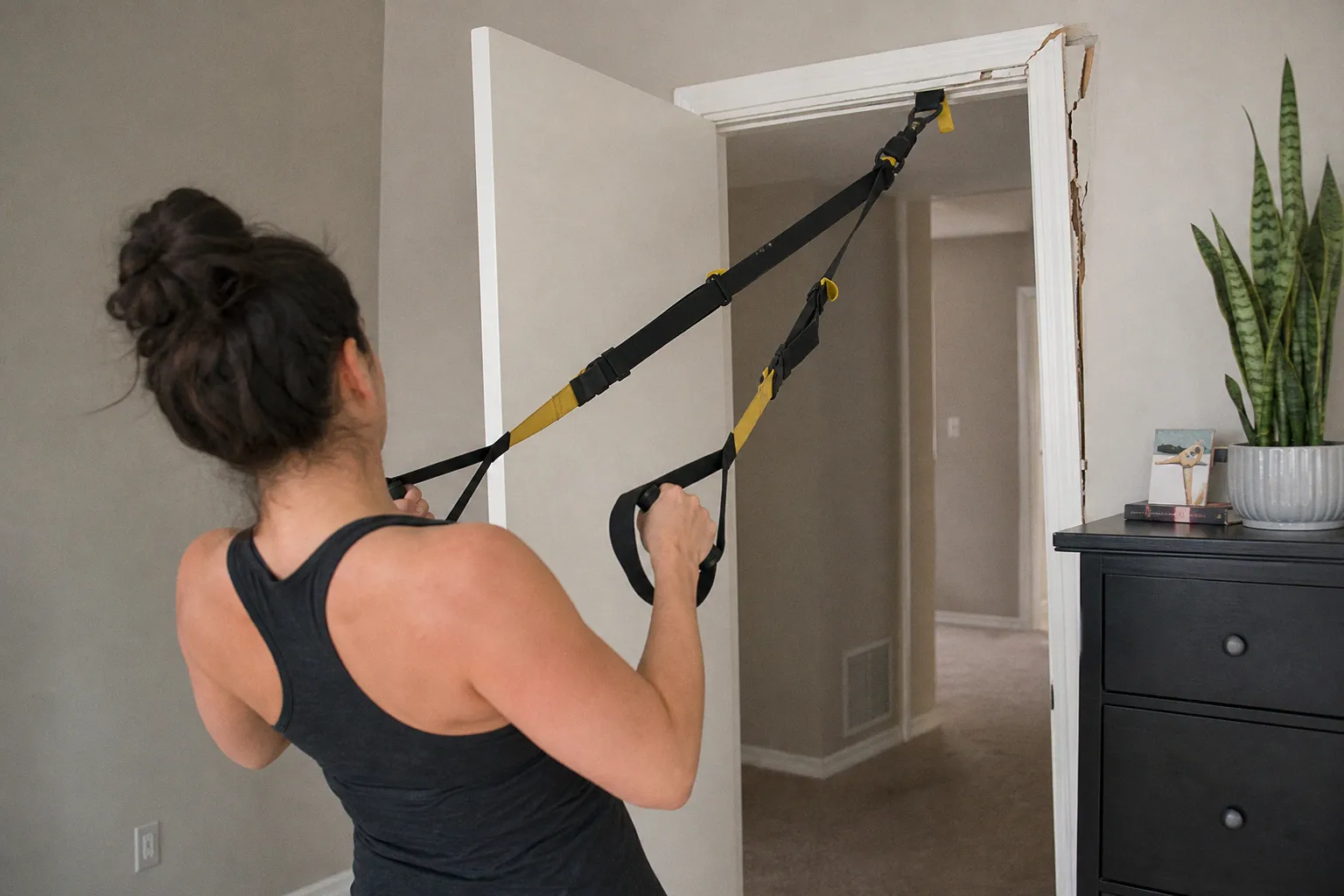
The ring curl is the closest thing to a bodyweight dumbbell curl. It is also where people expose poor setup discipline. If the straps are too high and the body is nearly vertical, resistance is trivial. If the straps are anchored badly, the exercise is unsafe. The movement is only as useful as the anchor is reliable.
Bodyweight does not mean bodyweight-only loading. It means using body position to decide how much of your mass reaches the elbow flexors.
The Supinated Grip Is Not a Detail
Grip choice changes the exercise.
An overhand pull-up is not useless for arm development. It trains the forearms, brachialis, upper back, and lats. But it is not the efficient choice if the stated objective is biceps hypertrophy. The biceps is mechanically disadvantaged when the forearm is pronated.
A supinated chin-up fixes that. Your palms face you. The biceps contributes more strongly to both elbow flexion and forearm positioning. The result is a movement that can carry a large part of a calisthenics bicep workout without pretending that lat work is arm isolation.
Use this hierarchy:
1. Supinated chin-ups for high-load compound work. Start from a controlled dead hang if the shoulders tolerate it. Pull until the chin clears the bar. Avoid kicking. Avoid the half-rep habit where the elbows never fully extend.
2. Neutral-grip chin-ups when wrists or elbows object to full supination. They usually reduce the direct biceps bias slightly, but are often easier on irritated tendons.
3. Supinated inverted rows for scalable volume. They let you accumulate quality repetitions without turning every set into a near-max vertical pull.
4. Ring curls or suspension curls for direct elbow-flexion volume after compound pulling.
5. Self-resistance curls when no anchor exists. Useful. Limited. Better than pretending furniture is gym equipment.
There is a practical reason not to make every set a chin-up. Vertical pulling has a high systemic cost relative to an inverted row or ring curl. Grip, upper-back fatigue, and shoulder stabilizers can cap the session before the biceps receives enough weekly work.
That is why a sensible bodyweight workout biceps plan uses chin-ups for heavy exposure and adjustable curl variations for additional sets.
The elbow path matters too. During ring curls, keep the upper arm relatively fixed and let the elbows bend. If the shoulders drift forward and the torso rises as one unit, the movement becomes a row. That is not fraud. It is simply a different exercise, with less direct biceps loading.
For chin-ups, a modestly narrow-to-shoulder-width supinated grip is generally the workable zone. Excessively narrow grips can irritate wrists. Very wide underhand grips often feel awkward because they are awkward. The biceps does not require circus positioning.
Progressive Overload Without a Dumbbell Rack
The limitation of home bodyweight training is not resistance. It is measurement.
With dumbbells, the number is stamped on the handle. With rings, you must create the number through geometry and execution. A ring curl performed at a 70-degree body angle is not the same exercise as one performed at 35 degrees. Counting both as “three sets of curls” says very little.
The most practical loading controls are these.
Change the body angle
For suspension curls, begin around a 45-degree body angle. This is not a sacred number. It is a useful starting point where many trainees can produce clean sets in the 10–20 rep range.
Walk your feet forward to become more horizontal. More of your body mass now acts against elbow flexion. The set gets harder.
Walk backward and become more upright. The exercise gets easier.
For supinated rows, lower the bar or elevate the feet. Both increase the percentage of body mass that must be moved. A straight line from shoulders to heels is the baseline. Bent knees are a regression, not a moral failure. They are just less load.
Extend the eccentric
A three- to four-second lowering phase is the cheapest way to make a light setup less light.
The lowering phase must be controlled, not merely slow. On a chin-up, descend from the top with the elbows gradually opening. On a ring curl, resist the handles as the arms straighten. If you collapse through the final third of the range, you removed the part you were trying to load.
A slow eccentric increases time under tension and makes momentum less available. It also increases soreness and tendon demand. Do not add it to every exercise, every set, forever.
Hold the shortened position
At peak elbow flexion, pause for one to two seconds.
For a ring curl, squeeze at the top without rolling the shoulders forward. For an inverted row, bring the handles or bar toward the lower ribs and pause before lowering. For a chin-up, avoid craning the neck to fake additional range. The elbows and shoulder position are doing the work, not the chin.
Peak holds are most useful on lighter movements. They are less necessary on hard chin-up sets where the body mass already supplies substantial resistance.
Add repetitions only within a valid range
For muscle growth, 10–20 reps is a workable target for many bodyweight curl and row variations. Harder chin-up variations may land in the 5–10 range. Easier exercises can work at 20–30 reps, provided the final reps are genuinely close to failure.
The target is not a magic rep count. The target is a set that ends with 0–2 reps in reserve.
If you could have completed eight more ring curls, the angle is wrong.
If you fail at four reps because your grip slips and the biceps was not near fatigue, the setup is wrong.
If your elbow hurts before the muscle is challenged, the exercise selection or progression speed is wrong.
A rep count without proximity to failure is bookkeeping. It is not evidence of overload.
A Weekly Structure That Can Actually Grow Biceps
The broad workable range for biceps hypertrophy is about 8–20 challenging sets per week. Beginners can grow on 6–10 sets if those sets are close to failure and the progression is not random.
The upper end is not a default. It is a recovery cost.
Chin-ups count. Supinated rows count. Ring curls count. But they do not all carry identical fatigue. A hard chin-up set may tax the lats, grip, and shoulder complex before the biceps becomes the limiting factor. A ring curl set can take the biceps closer to local failure with less total fatigue.
This is why volume should not be measured by exercise novelty. It should be measured by hard, repeatable sets.
A basic twice-weekly setup is enough for most people training at home:
| Day | Exercise | Sets | Rep target | Execution |
|---|---|---|---|---|
| Day 1 | Supinated chin-up | 3–4 | 5–10 | Controlled full range; 0–2 RIR |
| Day 1 | Ring or suspension curl | 3 | 10–20 | 3-second eccentric |
| Day 1 | Supinated inverted row | 2 | 10–15 | 1-second top hold |
| Day 2 | Supinated inverted row, feet elevated if viable | 3–4 | 8–15 | Strict torso position |
| Day 2 | Ring or suspension curl | 3–4 | 10–20 | Adjust angle as needed |
| Day 2 | Self-resistance or towel curl | 2 | 15–30 or timed | Near-max effort, controlled lowering |
That produces 13–18 direct or strongly biceps-relevant sets. For a beginner, remove one or two sets from each day. The point is to recover, then add performance. Not to turn forearm soreness into a personality trait.
Rest periods should match the exercise.
Take roughly two to three minutes after challenging chin-up and hard row sets. Take 60–90 seconds after ring curls and self-resistance work. Short rests are not automatically more “intense.” They often just reduce repetition quality and force the shoulders to compensate.
Track three items:
- Body angle or bar height.
- Repetitions achieved at a fixed tempo.
- Reps in reserve at the end of the final work set.
If last week’s ring curl was 12 reps at a 45-degree angle with a three-second eccentric, do not report “12 reps” this week while standing more upright and calling it progress. Home training requires more honesty because there is less external load to expose the lie.
The Ring Curl: The Best Isolation Tool Most Homes Can Use
A suspension trainer or gymnastics rings provide the cleanest answer to how to build biceps at home with minimal equipment.
They allow a curl pattern with adjustable resistance. They also force the stabilizers around the shoulder and wrist to work. That is useful up to a point. If the rings are swinging everywhere, the biceps is no longer the limiting tissue. Stabilize first.
Set the straps to roughly waist height. Stand facing the anchor. Grip the handles with palms up. Lean back with a rigid body. Begin with arms extended, then curl the hands toward the forehead while keeping the elbows high and relatively fixed.
The common failures are mechanical:
- Hips drifting backward or forward: This changes the body angle mid-set and unloads the arms.
- Elbows dropping: The movement becomes more like a row.
- Wrists folding back: This shifts stress into the wrist and weakens force transfer.
- Turning every rep into a full-body wave: Momentum replaces tension.
- Starting too horizontal: Form breaks at rep four, then the trainee blames the equipment.
Use a body angle that gives you 10–20 strict reps. Once you can exceed the top end with the prescribed tempo and a brief peak hold, move the feet forward by a small amount. That is progressive overload. It is boring. It works.
The same logic applies to inverted bicep rows. Use a bar or rings low enough that your body is close to horizontal, but not so low that the last few reps require a hip snap. Elevate the feet only when standard straight-leg rows are no longer demanding.
For context, strength training also has effects beyond the local muscle. The comparison between aerobic and resistance work on cognition is more nuanced than the usual cardio-versus-weights argument; this overview of exercise and neuroplasticity across both training modes is a useful correction to the false binary. It does not change the biceps programming rule: train the tissue with enough tension, then recover.
Towel Curls and Self-Resistance: Useful, but Not Equal
No pull-up bar. No rings. No solid anchor.
You can still train elbow flexion. But the ceiling is lower because self-resistance is difficult to quantify and easy to underload.
A towel is a simple option. Stand on the midpoint of a towel and grip each end with palms facing upward. Curl against the tension created by pressing your feet into the towel. The problem is obvious: the loading is partly determined by how hard you choose to resist. Most people choose less resistance as fatigue rises.
Self-resistance curls are more controllable. Curl one arm while the other hand presses down against the working forearm or wrist. The non-working arm supplies the load. On the eccentric, resist the lowering aggressively.
Use these methods as finishers or as a temporary substitute, not as the centerpiece of advanced training. They can create high maximal voluntary isometric contraction. They cannot match the repeatability of a bar, rings, or stable suspension setup.
A practical protocol:
1. Curl the working arm through a slow concentric over two seconds.
2. Apply enough opposing force that the rep takes effort immediately.
3. Hold near full elbow flexion for one to two seconds.
4. Lower for three to four seconds while the opposing hand continues to resist.
5. Continue until the working arm cannot maintain position without reducing the opposing force.
That final condition matters. If you are manually lowering resistance to keep the set going, the set may still be useful, but the log should reflect it. Do not compare it directly to a fixed ring-curl progression.
The Limits of Bodyweight Bicep Training
Bodyweight bicep exercises can build muscle. They are not magic, and they are not automatically superior to dumbbells.
Their main advantage is accessibility. A pull-up bar and rings create a scalable system with a low equipment footprint. Their main weakness is that load jumps can be awkward once a trainee becomes strong. Moving your feet six inches changes a ring curl, but not with the precision of adding a small plate to a cable stack.
Advanced trainees may eventually need external loading, weighted chin-ups, bands, or more difficult leverage positions to keep progression moving. That is not a failure of calisthenics. It is basic load management.
The other limit is elbow tolerance. Supinated gripping places repeated demand on the biceps tendon and forearm flexors. Going from zero pulling volume to 20 hard sets in a week is poor programming. Tendons adapt more slowly than enthusiasm.
Start with six to 10 hard weekly sets if you are new to pulling. Keep the eccentric controlled but not punitive. Add volume only when performance is stable, elbows are quiet, and the final sets are not degrading into shortened reps.
Dave’s home success story, stripped of the usual transformation nonsense, is not dramatic. He uses chin-ups for high-tension compound work. He uses ring curls for direct volume. He logs angle, reps, tempo, and proximity to failure. He progresses one variable at a time.
That is the whole mechanism.
Verdict: do it if you have a secure pull-up bar or reliable suspension anchor and can train near failure with measurable progression. Skip it if the plan is random pull-ups, loose towel curls, and rep counts detached from load. Bodyweight can build biceps. Unmeasured bodyweight training usually builds excuses.