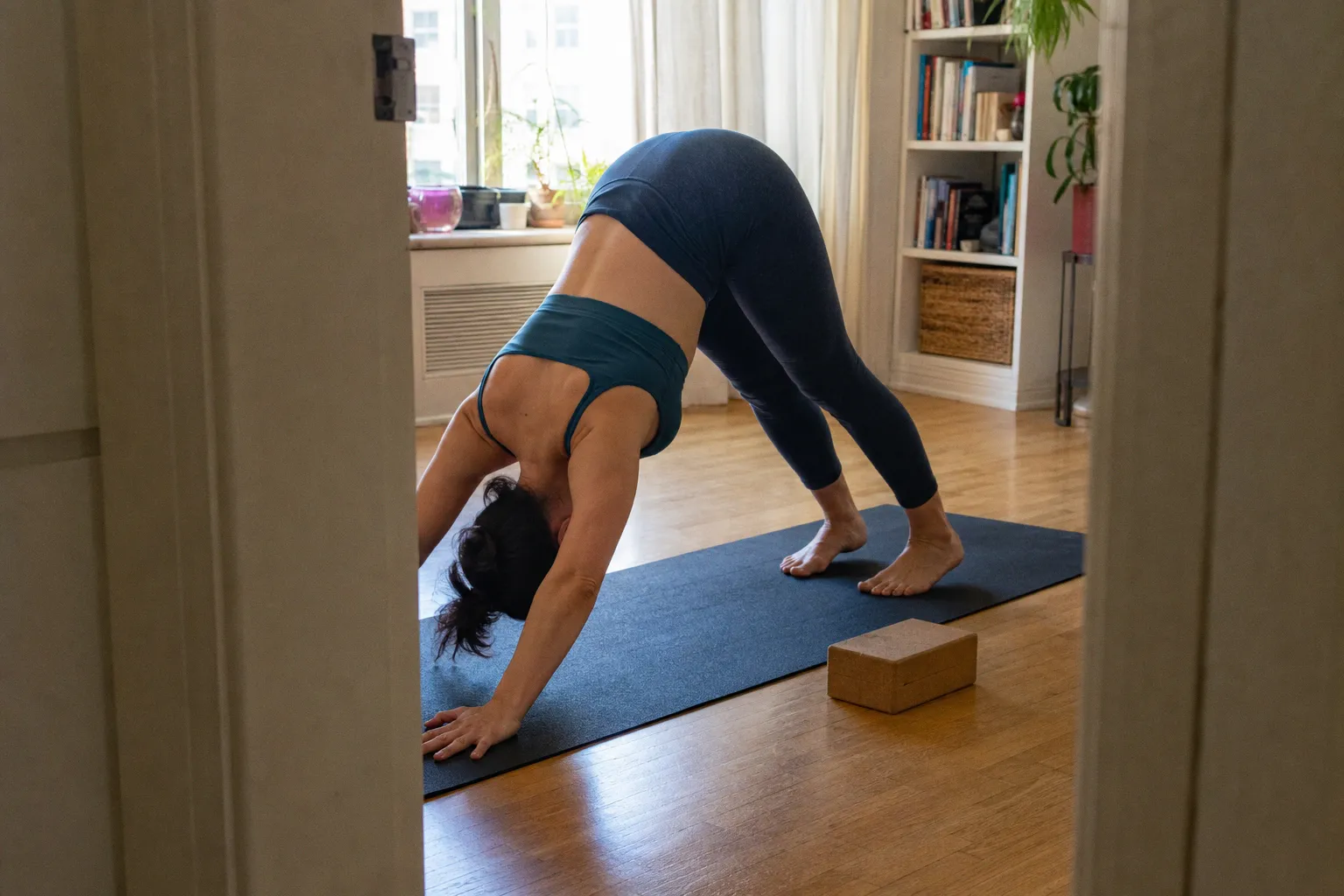
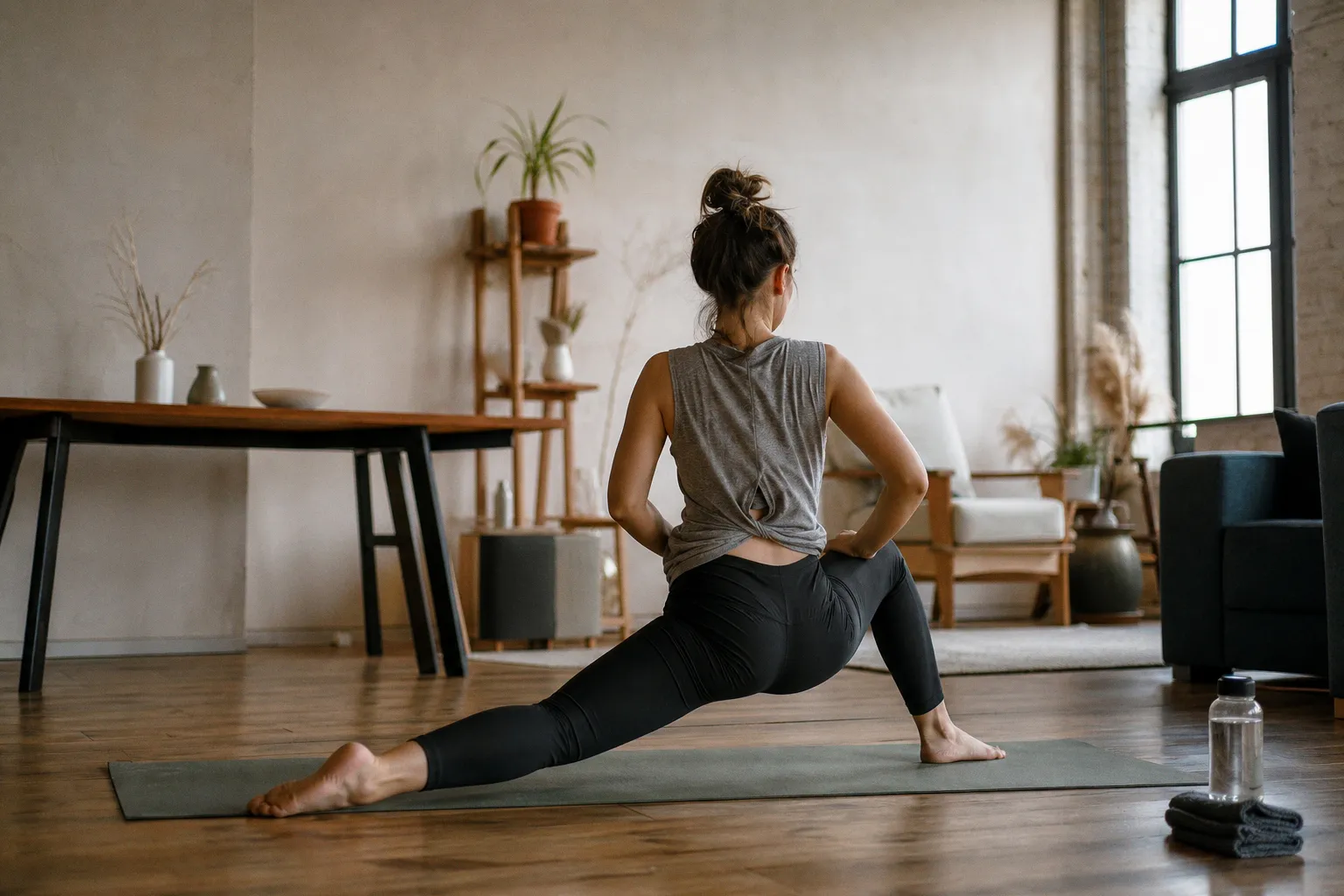
Ten minutes is not a transformation window. It is a compliance window. That matters more.
A stretching routine for beginners fails when it asks for 35 minutes, six positions, a yoga block, a strap, a quiet room, and a personality transplant. A 10-minute daily stretching routine works because the cost is low enough to repeat. Repeat exposure is the lever. Not intensity. Not pain. Not a dramatic forward fold on day three.
"Sarah's routine" here is a practical model: a normal beginner habit built around 10 minutes, low load, simple floor positions, and ACSM-aligned timing. No circus mobility. No fake promise that stretching melts soreness or permanently lengthens muscle fibers. The realistic target is better range of motion, better stretch tolerance, and less stiffness through the joints you actually use.
That is enough.
The science of flexibility: consistency beats intensity
Flexibility is not won by attacking the hamstrings once a week like they owe you money.
The American College of Sports Medicine recommends flexibility exercises at least 2–3 times per week for healthy adults. Daily work tends to be more effective for improving range of motion. That does not mean daily maximal stretching. It means repeated, controlled exposure.
Beginners usually make the same mechanical error: they chase depth. The body reads that as threat. The nervous system adds braking force. The stretch gets worse.
The better input is boring:
- low intensity;
- mild discomfort only;
- steady breathing;
- repeated holds;
- no sharp pain;
- no bouncing into end range.
That last point is not cosmetic. Ballistic bouncing can create more force than a beginner can control. Especially at the hamstring, hip flexor, calf, and adductor positions. Connective tissue does not care about motivation. It cares about load, angle, speed, and recovery.
Flexibility improves when the nervous system stops treating the position as a threat. Pain is not proof of progress. It is bad data.
A beginner flexibility exercise should feel like a position you can own. Not survive.
For a 10-minute plan, the useful split is simple: use dynamic movement first, then static holds. Dynamic stretching works better before training because it raises temperature and prepares joints through motion. Static stretching fits better after a workout, after a warm shower, or as a standalone routine once the body is warm.
Static holds have a useful timing range: 10–30 seconds for most adults. Older adults may benefit from 30–60 seconds. That does not mean longer is always better. It means the dose must match the body and the goal.
A 10-minute stretching routine for beginners is not trying to produce elite hip mobility. It is trying to build an executable baseline.
Do not stretch cold and call it discipline
Cold stretching is one of the cleaner ways to turn a good habit into a bad signal.
Clinical guidance is consistent here: warm up first. A 5–10 minute light aerobic warm-up is recommended before stretching. Walking, easy cycling, marching in place, or low-impact step-ups all work. The job is not conditioning. The job is temperature and blood flow.
This is where the "morning stretch routine" needs a correction. Morning tissue stiffness is real. You have been horizontal for hours. Joint fluid distribution has changed. Muscles are not ready for aggressive end-range positions.
So if Sarah does her 10 minutes in the morning, the first minute is not a deep hamstring fold. It is joint prep.
Good options:
1. March in place for 60–90 seconds. Keep it easy. Raise body temperature. No performance target.
2. Add arm circles and shoulder rolls. Small circles first. Larger circles only if the shoulder joint tracks cleanly.
3. Use hip circles or slow standing knee lifts. The hip joint needs motion before deep flexion.
4. Run cat-cow before static floor work. Spinal flexion and extension at low load are more useful than forcing a seated fold cold.
If the stretching routine follows a workout, the warm-up is already done. That is the cleaner setup. Post-workout static stretching is easier to dose because the tissue is already warm and the heart rate is coming down.
If this is a standalone daily stretching routine, add at least a few minutes of easy movement before the 10-minute block. If the schedule only allows exactly 10 minutes total, bias the first two minutes toward dynamic mobility, not static holds.
That is the trade. Not negotiable.
Sarah's 10-minute sequence: simple, timed, repeatable
This is a beginner routine. It uses common positions: cat-cow, child's pose, hip flexor stretch, hamstring stretch, calf stretch, thoracic rotation, and a basic figure-four glute stretch.
The sequence is not designed to look impressive. It is designed to remove decision fatigue.
Use a timer. Stop guessing.
| Minute | Movement | Type | Target area | Dose |
|---|---|---|---|---|
| 0:00–1:00 | March in place with shoulder rolls | Dynamic warm-up | Ankles, hips, shoulders | Easy pace |
| 1:00–2:00 | Cat-cow | Dynamic mobility | Spine, rib cage | 6–8 slow reps |
| 2:00–3:00 | Child's pose with side reach | Static / active | Lats, lower back | 20 sec center, 20 sec each side |
| 3:00–4:30 | Half-kneeling hip flexor stretch | Static | Hip flexors, quads | 30 sec each side, plus setup |
| 4:30–6:00 | Supine hamstring stretch | Static | Hamstrings | 30 sec each side, plus transition |
| 6:00–7:00 | Wall calf stretch | Static | Gastrocnemius, soleus | 30 sec each side |
| 7:00–8:30 | Figure-four glute stretch | Static | Glutes, posterior hip | 30 sec each side, plus transition |
| 8:30–9:30 | Open-book thoracic rotation | Dynamic / controlled | Upper back, ribs | 4–5 reps each side |
| 9:30–10:00 | Slow nasal breathing in a comfortable position | Downshift | Diaphragm, nervous system | 5–6 slow breaths |
The plan has one flaw. It is tight. Ten minutes always is.
Transitions matter. Beginners often spend a surprising chunk of their routine fumbling through position changes: figuring out which knee comes down, where the foot lands, how to face the wall without dragging the yoga mat across the room. That quiet friction adds up. It is one of the silent reasons people quietly abandon flexibility work after the first week. The sequence above uses positions that flow from floor to standing and back only once. Less choreography. Better adherence.
How each stretch should actually be done
Cat-cow.
Hands under shoulders. Knees under hips. Move the spine one segment at a time if possible. Inhale into extension. Exhale into flexion. Do not slam the neck upward. The cervical spine is not the main event.
Child's pose with side reach.
Sit the hips back. Arms forward. Then walk both hands slightly to the right and breathe into the left side ribs. Repeat left. This is not a passive collapse. Keep the hands lightly active against the floor.
Half-kneeling hip flexor stretch.
Back knee down. Front foot planted. Tuck the pelvis slightly. Think belt buckle up, ribs down. If the lower back arches, the hip flexor is no longer taking the clean load. Hold 30 seconds per side.
Supine hamstring stretch.
Lie on the back. One leg up. Use hands behind the thigh or a towel if needed. Keep the raised knee slightly bent. The goal is tension behind the thigh, not a locked-knee nerve tug. If symptoms travel sharply below the knee, reduce range.
Wall calf stretch.
Hands on wall. Back leg straight for gastrocnemius. Then slightly bend the back knee if you want more soleus. Keep the heel down. Do not turn the foot out to cheat range.
Figure-four glute stretch.
On the back. Cross one ankle over the opposite thigh. Pull the thigh toward the torso. Keep the pelvis level. If the knee feels irritated, reduce the angle.
Open-book rotation.
Side-lying. Knees bent. Rotate the top arm open. Follow with the eyes if the neck tolerates it. Keep the knees stacked. If the knees separate wildly, the rotation has moved from thoracic spine to lumbar compensation.
The hold time problem: more is not automatically better
Beginners often ask whether a 60-second hold is better than a 20-second hold.
Wrong first question.
The better question: can the position be held without guarding?
Static stretches should usually be held for 10–30 seconds for most adults. That is enough to create a useful flexibility stimulus without turning the position into a tolerance contest. For older adults, 30–60 seconds may be more effective.
But hold time does not rescue bad mechanics. A 45-second hamstring stretch with a rounded lumbar spine and clenched jaw is not superior. It is just longer.
Use this dosing rule:
| Situation | Better dose | Reason |
|---|---|---|
| New beginner, stiff in most positions | 10–20 seconds | Lower threat, easier repeatability |
| Healthy adult with basic control | 20–30 seconds | Standard effective static range |
| Older